
Summary
Close a ground-only STTBOT-T1 inspection only when the reviewer can match the approved request and route revision to actual motion, usable evidence at every required checkpoint, and a confirmed final location. Reconcile the console record with an independent observation log. Hold the work order open when an essential record is missing, a required checkpoint was skipped, or the robot never moved after approval. The proposed San José, Costa Rica, evaluation compares these closure decisions across scripted cases and scores false closures.
Key Takeaways
- Freeze the approved route revision, mandatory checkpoints, and evidence criteria before dispatch.
- Record actual motion start and end separately from request approval and command acknowledgement.
- Require each checkpoint record to identify the location, observation source, finding, evidence quality, and supporting material.
- Have an observer record physical events independently and flag any limits on visibility.
- Hold the inspection open when a material conflict or missing record leaves completion unverified, and assign an owner to resolve the gap.
- Ask the supplier to demonstrate what a reviewer can retrieve for a completed route, a skipped checkpoint, and an approved request with no motion.
Proposed problem
The buyer needs to determine whether the available evidence supports closing a ground-only work order. The reviewer must distinguish missing execution, a skipped inspection point, and a checkpoint visit that produced insufficient evidence of the requested feature. Each gap calls for a different follow-up.
Hypothetical evaluation assumption: Use an observation-only route at a site to be selected by survey in San José.
Choose accessible inspection points with identifiable features and a defined finish point. Specify what the reviewer needs to establish from each observation, such as whether a designated indicator is readable from the approved viewing position. A properly documented adverse finding may satisfy the inspection requirement while creating a separate corrective action.
Source-backed product boundary
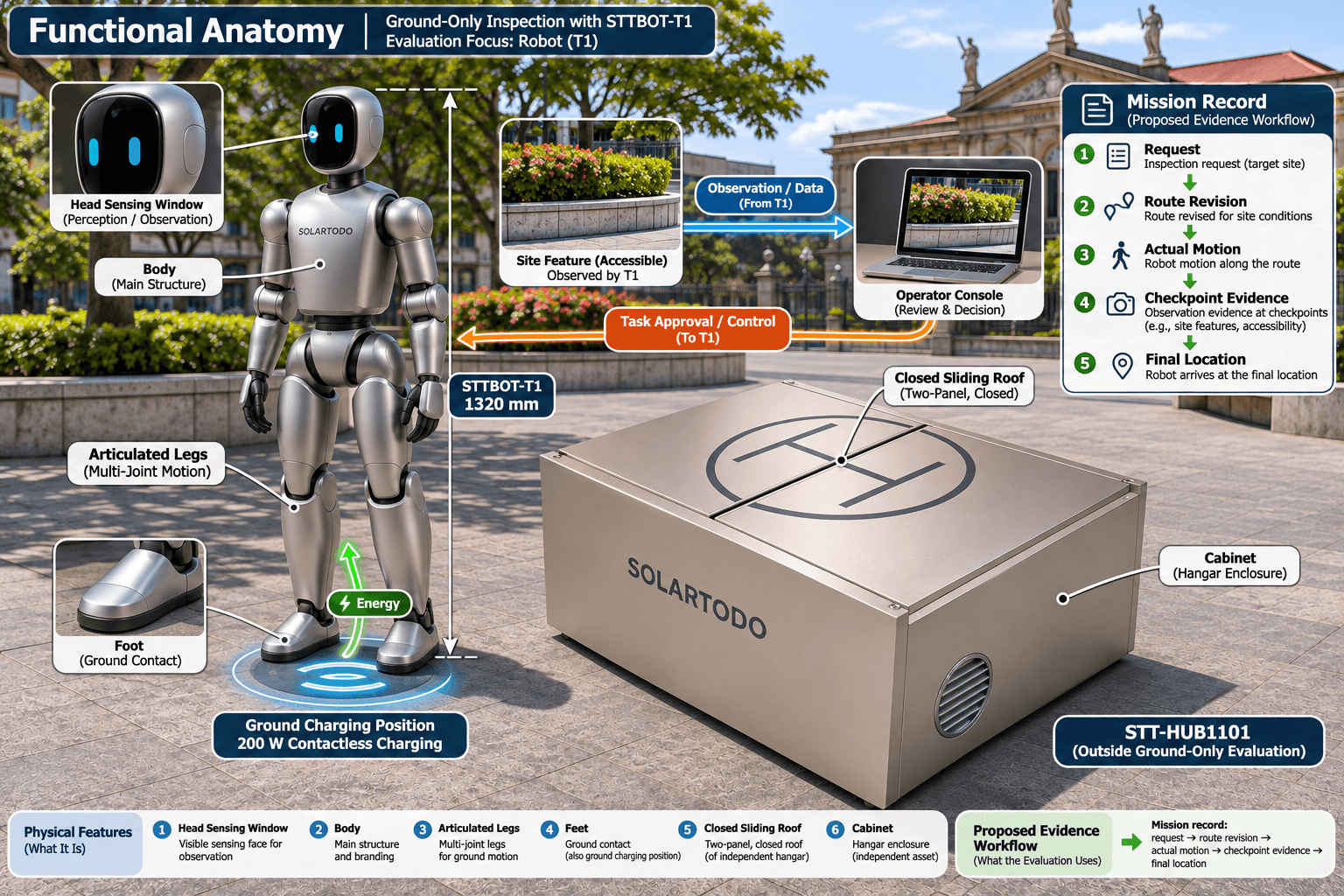
The SkyHub English product manual, Rev 1.3, identifies the STT 1S MAX aircraft, the STT-HUB1101 battery exchange hangar, and the distinct STTBOT-S1 and STTBOT-T1 ground robots. The hangar section describes the independent configuration paired with the aircraft and its matched battery module. The aircraft and hangar are outside the proposed ground-only evaluation, which uses the STTBOT-T1. SkyHub manual, page 1, product family, page 24, STT-HUB1101 applicability.
Page 57 describes the ground robots' common SkyHub task interface, their ability to report operating state, and their inspection role observing accessible features. The ground inspection entry specifies operator review of the task area and walking path. SkyHub manual, page 57, ground mission roles.
Page 58 lists the T1 at 1320 mm standing height, approximately 35 kg including battery, and 450 × 200 mm standing width × depth. It also lists a 200 W contactless charging module for the T1. Use the supplied T1 configuration and a physical route survey to assess moving clearance, including at turns. Page 59 identifies the supplied-unit record as the source for the S1 outside envelope and the tool actually fitted to each robot. SkyHub manual, page 58, model comparison, page 59, configuration and measurement definitions.
Page 77 lists event, task and request IDs, route revision, purpose, checkpoints, operator approvals, actual motion times, and final location under the mission record. It lists observation source, timestamp, location confidence, sensor-health status, and a controlled media reference under the perception and evidence record. Verify which fields the supplier can make available for review in the proposed configuration and how the reviewer can retrieve them. SkyHub manual, page 77, robot operating and maintenance record.
Proposed design
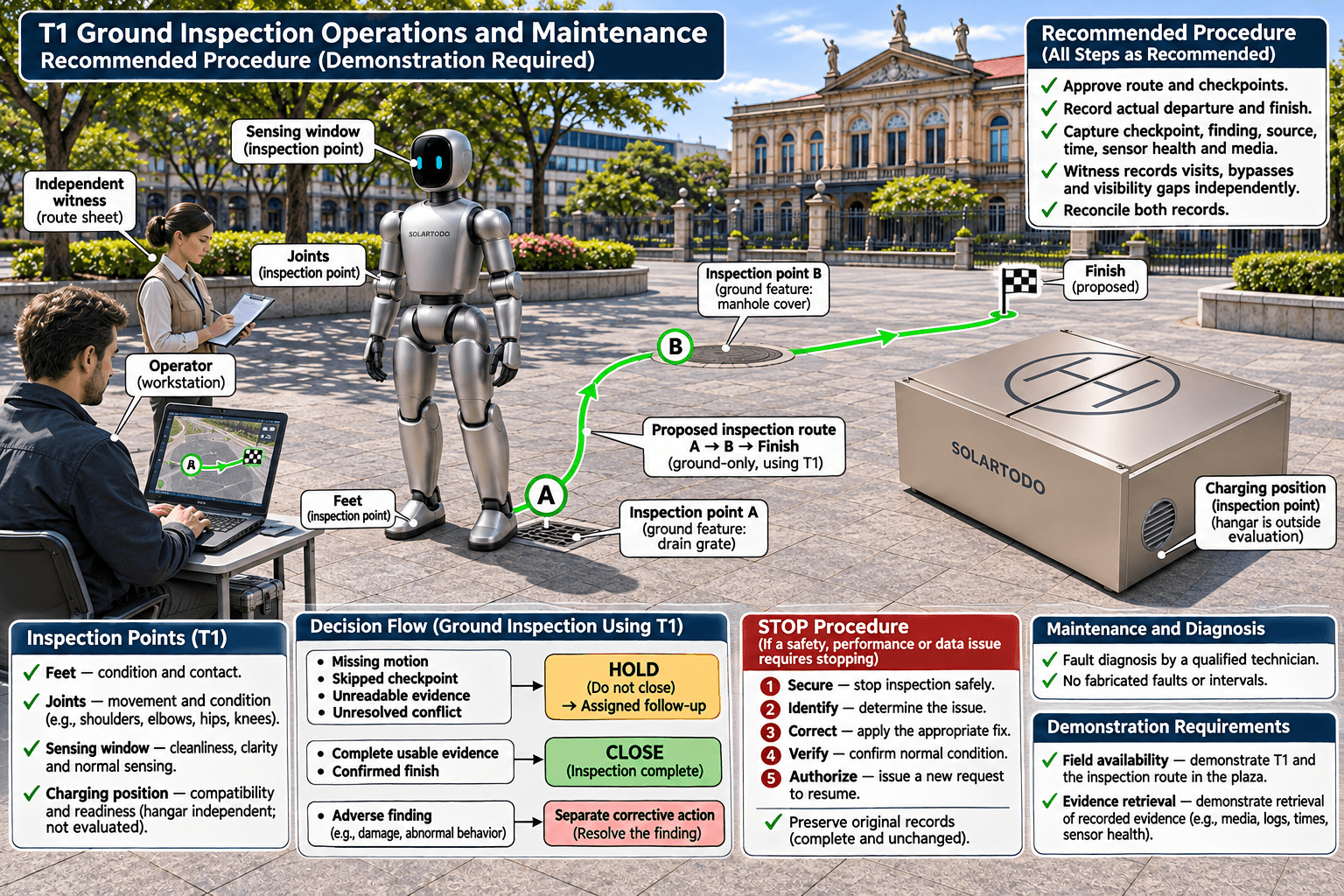
Freeze the mission record. Before dispatch, record the work-order reference, event, task and request IDs, mission purpose, site zone, robot model and serial, and approved route revision. Keep the checkpoint list with the route revision and record who approved it and when. Use the work-order reference to link the evidence to the inspection decision. If the route changes, preserve the original scope and record who authorized the change and which checkpoint obligations it affected.
Distinguish permission, execution, and evidence. Capture actual motion start and end, final location, and any interruption that affected the inspection. For each required checkpoint, record its ID, observed time, observation source, location confidence, sensor-health status, finding, and a controlled media reference where the checklist requires media. Check that the evidence establishes both the visit to the intended location and the observation of the requested feature. If an image establishes location but leaves the feature unreadable, keep the checkpoint open for authorized follow-up and retain the original observation.
Keep the observation log independent. Have a witness use the approved route sheet to record actual departure, observed checkpoint visits or bypasses, visible holds, stop time, and observed final location. Record the observer's identity and time basis, and mark periods when the robot was out of view. Finalize the log before comparing it with the console. Match events using shared identifiers and a documented time reference. Where the witness can see the visit but cannot see the feature, use the witness log to corroborate the visit and the checkpoint evidence to assess the finding.
Record the review decision. For each checkpoint, compare the approved scope, console evidence, and independent observation. Mark the checkpoint supported, missing, or disputed and cite the records behind the decision. Record who reviewed the work, when they decided, and who owns each follow-up. Preserve original entries when adding a correction. If an interruption involves a STOP condition, retain the original sequence and release evidence. Page 76 calls for recording a new task request ID at release during controlled recovery. Link the interrupted work to any subsequent authorized execution in the closure record. SkyHub manual, page 76, fault records and controlled recovery.
Hypothetical evaluation assumptions and scoring
Hypothetical evaluation assumption: Run the completed-route, skipped-checkpoint, and approved-with-no-motion cases three times each under the scripted site procedure.
Hypothetical evaluation assumption: Treat console and observer event times as directly comparable only when their time references differ by no more than two seconds at both the start and end of a trial.
Hypothetical evaluation assumption: Require usable evidence for 100% of mandatory checkpoints in every trial proposed for closure.
Hypothetical evaluation assumption: Set a target of zero false closures among review decisions adjudicated as incomplete or unverified.
Completed route
Hypothetical evaluation assumption: Script a run in which the robot visits every mandatory checkpoint, produces the specified observations, and reaches the designated finish.
Compare the console's actual motion and checkpoint records with the witness log before closing. For a separate review of the same run, withhold a required record from the review packet and check whether the reviewer keeps the work order open. Keep the original packet intact for adjudication.
Skipped checkpoint
Hypothetical evaluation assumption: Script a bypass on a surveyed test path while keeping the bypassed checkpoint mandatory on the work order.
Have the witness record the bypass and the final location if observed. Check whether the reviewer keeps the work order open and identifies the skipped checkpoint even if the endpoint was reached.
Approved request with no motion
Hypothetical evaluation assumption: Use a prearranged hold after operator approval to test review of a request with no ground motion during the scripted observation window.
Have the observer record the hold, the robot's position, and any gaps in coverage. Compare the log with the approval record, any actual motion records, and any recorded final position. Keep the order open and record whether the available evidence confirms no motion or leaves execution unverified.
Count a false closure when the reviewer marks an inspection complete and adjudication finds that mandatory work was incomplete or a required record was unavailable or unresolved at the time of review. For the false-closure rate, divide the count by the number of review decisions adjudicated as incomplete or unverified. Score the withheld-record review separately from the full-packet review of the same run. Report the counts and rate by scenario, and report the rate as unavailable where there are no eligible decisions. Record the reasons for correct holds, holds on fully evidenced work, and cases that cannot be adjudicated. NIST's ground robot methods provide context for scripted procedures, repeated trials, and quantitative metrics. NIST Ground Robot Tests.
Survey and acceptance checklist
- Walk the proposed route with the site owner. Verify access, checkpoint visibility, turns, surface transitions, observer positions, and how a held or interrupted trial will end.
- Record the T1 serial, fitted configuration, and software and motion-profile revisions for the unit used in the evaluation. Match that unit to the evidence packet.
- Approve the route revision and define the required feature, acceptable viewpoint, and retained evidence for each checkpoint.
- Demonstrate that a reviewer can retrieve the mission fields, checkpoint records, and required supporting evidence after the trial. Check the observer and console time references and document any clock discrepancy.
- Keep the work order open if the request or robot identity cannot be reconciled, the approved scope is missing, actual motion times or final location remain unverified, a mandatory checkpoint lacks usable evidence, or a material discrepancy remains unresolved.
- Retain the console records used for review, witness log, supporting observations, and signed or otherwise attributed decision together so another reviewer can trace the disposition.
Limitations
Field availability, timestamp handling, and evidence retrieval require a demonstration with the unit selected for the evaluation. The proposed route, witness coverage, and review procedure still need to be surveyed and tested in San José. Any resulting score would apply to the tested configuration, route, evidence packet, and review procedure. The NIST aerial FAQ provides background on scoring repeatable tasks and setting evaluation thresholds. NIST aerial drone tests FAQ.
Procurement questions
Ask the supplier which required fields a reviewer can access in the console, whether any can be exported, and which would need a controlled supplemental record. Ask to see approval, actual motion, interruption, and final-location evidence from a sample task. Check whether skipped or unobserved checkpoints are distinguishable, where location confidence and sensor health are recorded, and how a reviewer would retrieve required original media. Ask the supplier to demonstrate how to trace an interrupted request to a later authorized attempt. Agree with the site owner on who retains evidence, who can amend the record, and who authorizes closure. SkyHub product page.
FAQ
Can an approved request close the work order?
Approval records permission. Closure requires evidence of actual execution, every required checkpoint, and the final location.
Which mission fields must the reviewer reconcile?
Reconcile event, task and request IDs, route revision, purpose, checkpoints, operator approvals, actual motion times, and final location against the work order and robot identity.
What makes checkpoint evidence usable?
It identifies the checkpoint and finding and ties them to a timestamp, observation source, location confidence, sensor-health status, and a retrievable controlled media reference when media is required.
What if the robot finishes after skipping a mandatory checkpoint?
Keep the work order open, record the skipped checkpoint, and obtain evidence through authorized follow-up work.
What should the independent observer record?
Record actual departure, checkpoint visits or bypasses, visible holds, stop time, final location, and any limits on visibility.
What if the console and witness disagree?
Preserve both records, check identity and time alignment, and keep the work order open until the material discrepancy is resolved.
What counts as a false closure?
A false closure occurs when a reviewer marks an inspection complete despite incomplete mandatory work or a required record that is unavailable or unresolved at the time of review.
Can an adverse finding still support inspection closure?
Yes. If the required inspection evidence is complete, close the inspection and track the adverse finding as a separate corrective action where appropriate.
References
- SkyHub Air–Ground Coordinated System, English product manual, Rev 1.3. Page 1, product family, page 24, independent STT-HUB1101 hangar, page 57, ground mission roles, page 58, S1 and T1 model comparison, page 59, configuration and specification notes, page 76, robot faults and recovery, page 77, robot mission and evidence records.
- Additional manual pages for equipment outside the proposed ground-only evaluation. Page 8, aircraft specification introduction, page 9, aircraft airframe and flight performance, page 10, aircraft performance and conditions, page 22, hangar introduction, page 25, hangar functions and mission cycle, page 27, hangar zones and operating states.
- U.S. NIST evaluation methodology context. Ground Robot Tests, Aerial Drone Tests FAQ.
Proposed Equipment
- STTBOT-T1 bipedal ground robot
- STTBOT-T1 assigned 200 W contactless charging module