San Juan coastal resilience needs and SOLARTODO Sentinel City AI Pole 104-node configuration guide
Summary
San Juan’s 329,737 residents, 68.86 inches of 2025 rain, and coastal flood exposure make a 104-node SOLARTODO Sentinel City AI Pole network a practical off-grid sensing and response configuration.
Key Takeaways
- A typical San Juan configuration would use approximately 104 SOLARTODO Sentinel City AI Pole nodes at about 40 m spacing, covering roughly 4.16 km of corridors.
- According to the U.S. Census Bureau (2025), San Juan municipio has an estimated 329,737 residents and a 2020 land area of 47.9 square miles.
- According to NWS San Juan (2026), the San Juan area recorded 68.86 inches of rain in 2025, above the 59.87-inch climate normal.
- Each Sky Hub pole is fully off-grid, using 5-20 kWh-class storage with on-pole solar replenishment around 1.0-1.3 kW DC clear-sky peak in high-irradiance conditions.
- Local power coordination should reference LUMA/PREPA practice around 4.16 kV, 7.2 kV, 8.32 kV, and 13.2 kV distribution, but the pole does not consume grid power.
- The recommended payload is edge AI, PTZ sensing, 9-parameter environmental monitoring, drone operations, robot charging, and human-authorized non-lethal C-UAS coordination.
- Coastal design should account for salt air, hurricane wind exposure, back-bay flooding, dense historic streets, and public procurement thresholds above $100,000 for goods.
Market Context for San Juan
San Juan’s coastal urban profile combines 329,737 residents, high visitor flows, flood-prone corridors, and island-grid fragility into a strong market for off-grid city AI poles.
San Juan is not a generic Latin American city-grid retrofit. It is a dense coastal capital with port, tourism, government, medical, university, and historic-district traffic compressed into a small municipality. According to the U.S. Census Bureau (2025), San Juan municipio had an estimated 329,737 residents in 2025, down from 342,259 in the 2020 Census, which means infrastructure spending must improve service coverage without assuming population growth will fund expansion.
Climate is the first sizing constraint. According to NWS San Juan (2026), the San Juan area recorded a 2025 mean temperature of 81.7°F, 75 days at or above 90°F, and 68.86 inches of precipitation. This supports sealed electronics, corrosion planning, drainage-aware foundations, and maintenance intervals designed for humid marine exposure rather than dry inland streets.
Flooding is the second constraint. The U.S. Army Corps of Engineers describes the San Juan Metro back-bay problem as storm surge, tide, and wave-driven flooding that damages critical infrastructure, commercial property, and residential areas. USACE states, “storm surge, tide, and waves cause extreme flooding,” which is directly relevant to pole base elevation, cabinet sealing, and placement outside known ponding points.
Grid context matters even though the SOLARTODO Sentinel City AI Pole is not grid-powered. According to EIA (2026), Puerto Rico consumes almost 80 times more energy than it produces, and 2025 fossil-fuel plants provided 93% of electric generating capacity. A fully off-grid pole avoids adding parasitic load to distribution feeders while still allowing de-identified event metadata to connect with municipal command systems.
Procurement also shapes deployment. Puerto Rico municipal purchasing law requires public bidding for goods above $100,000 and public works above $200,000, while the 2026 GSA Regulation 9734 strengthens competitive procurement for goods, works, and nonprofessional services. For SOLARTODO, a San Juan bid package should separate equipment supply, installation, commissioning, cyber/privacy controls, and maintenance scope so evaluators can compare technical compliance rather than only headline price.
Recommended Technical Configuration
A typical 104-node SOLARTODO Sentinel City AI Pole deployment would prioritize flood corridors, port-adjacent routes, civic zones, and perimeter segments at 40 m spacing.
The recommended San Juan configuration is a 104-node Sky Hub pole-form network, subject to civil, permitting, wind, geotechnical, and radio-frequency confirmation. At approximately 40 m spacing, the lineal coverage is about 4.16 km before accounting for intersections, sightline offsets, curves, and restricted historic streets. This density is appropriate for anonymous vehicle counts, crowd-density estimation, environmental sensing, local alerts, and dispatchable drone or robot response in constrained urban corridors.
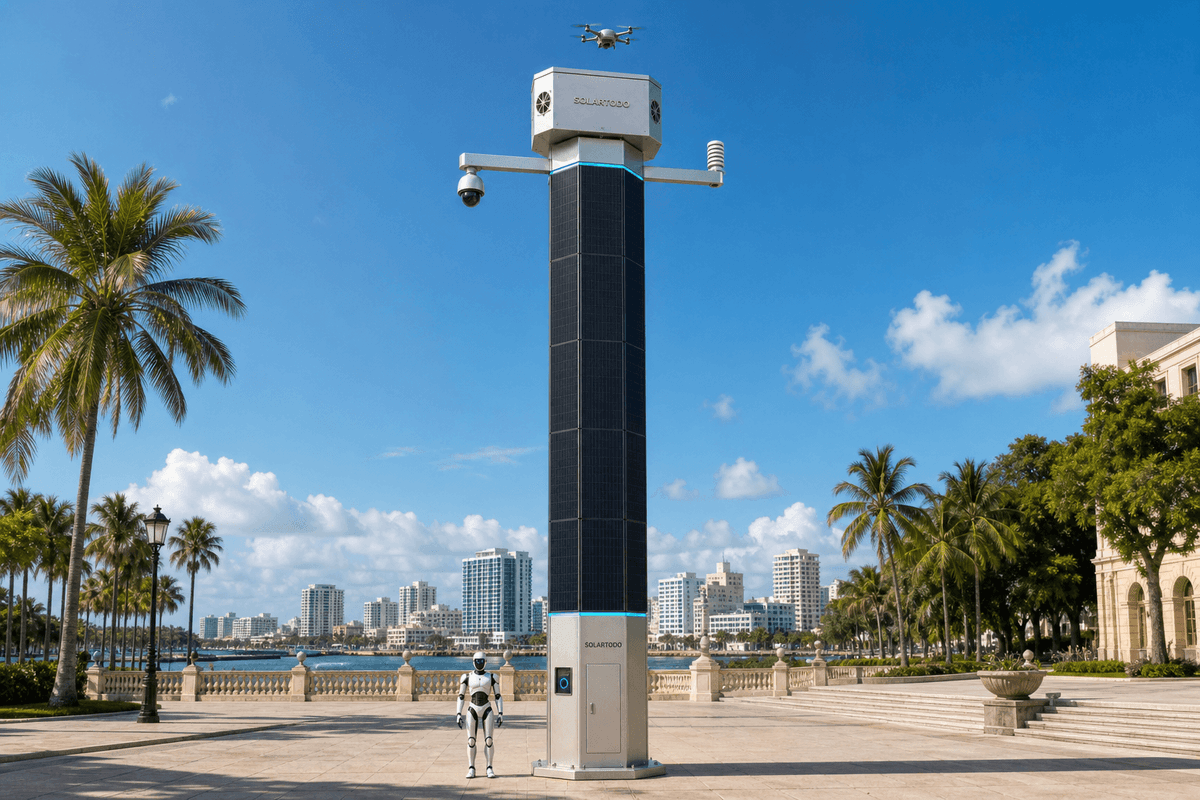
A typical deployment in this profile would consist of project-based custom units with local edge compute, a PTZ sensor suite, environmental monitoring, drone launch and battery exchange, and robot docking at the pole base. The SOLARTODO Sentinel City AI Pole should be treated as a city edge node, not as a streetlight or utility pole attachment. It includes no lighting system and should be specified as sensing, compute, energy storage, aerial operations, robotic operations, and command coordination infrastructure.
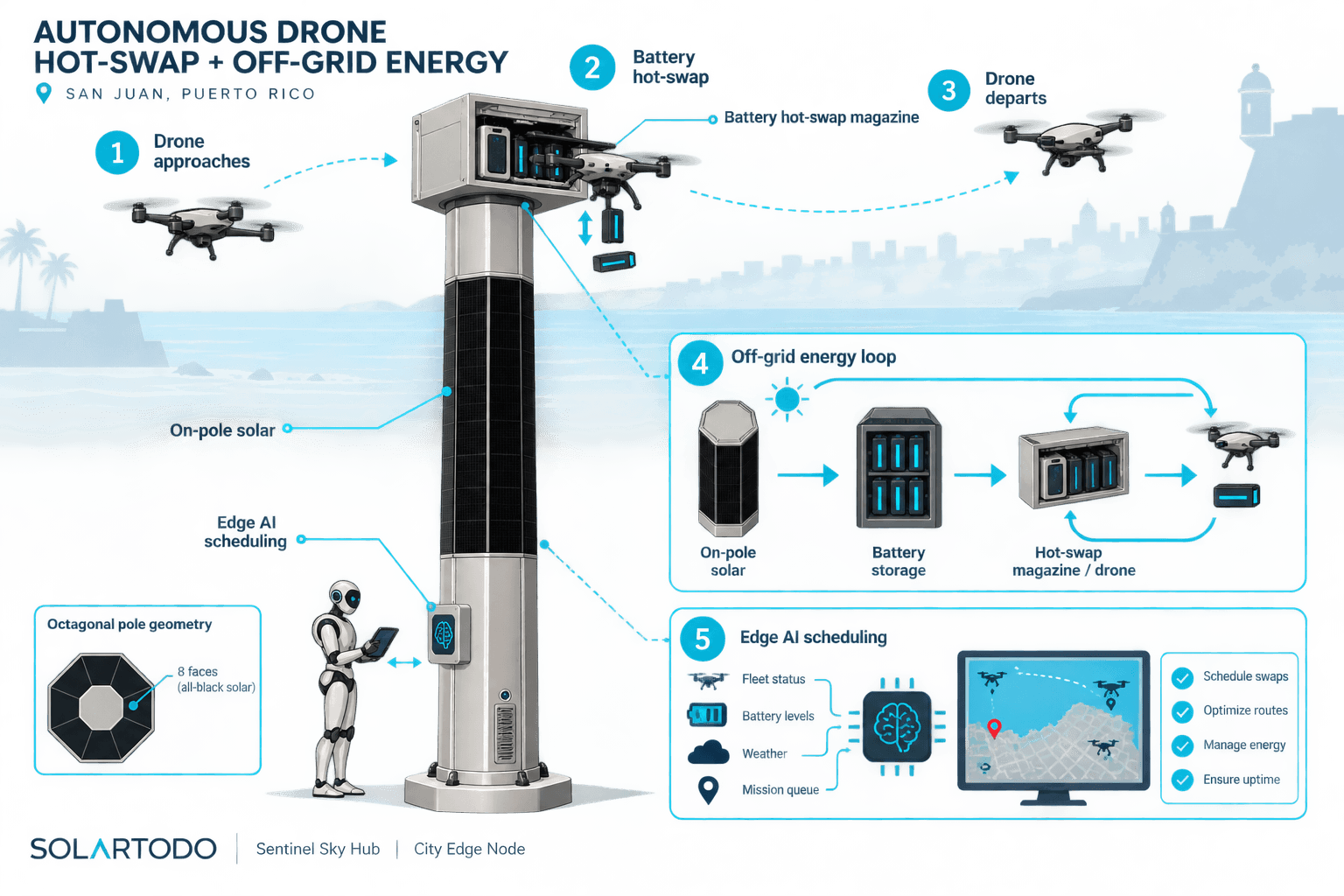
Power design should be framed carefully. Each node is fully off-grid with battery storage and integrated on-pole solar replenishment; it should not depend on municipal, site, or utility power. The on-pole solar layer is a replenishment source, typically around 1.0-1.3 kW DC clear-sky peak in high-irradiance conditions, with high-duty drone and robot tasks buffered by 5-20 kWh-class storage and scheduled by operating profile.
Because San Juan has salt air, hurricane-season rain, and flood-prone roads, the engineering confirmation should start with site classes. Waterfront, back-bay, and low-elevation corridors need higher corrosion protection, elevated service access, sealed edge-compute cabinets, and conservative drainage detailing. Old San Juan and port-adjacent segments may also require smaller construction windows, traffic management, archaeological or heritage coordination, and staged delivery instead of broad simultaneous excavation.
Technical Specifications
The San Juan configuration should specify 104 off-grid edge nodes, 5-20 kWh-class storage, 9-parameter environmental sensing, and local processing by default.
- Product: SOLARTODO Sentinel City AI Pole, Sky Hub pole-form physical-AI city edge node.
- Quantity basis: approximately 104 units, project-based custom configuration, subject to engineering confirmation.
- Spacing basis: about 40 m typical spacing, adjusted for intersections, flood zones, sightlines, and permitting boundaries.
- Energy architecture: fully off-grid battery-backed micro-station with on-pole solar replenishment; no grid, city, or site power dependency.
- Storage class: 5-20 kWh battery buffer, selected by sortie frequency, sensor duty cycle, and communications load.
- Solar replenishment: approximately 1.0-1.3 kW DC clear-sky peak in high-irradiance conditions, used as supplemental replenishment rather than unlimited self-sufficiency.
- Edge compute: Jetson-class module for local inference, workload scheduling, health monitoring, and event filtering.
- Data handling: raw video and sensor streams remain on the pole; only de-identified event and status metadata should leave the node.
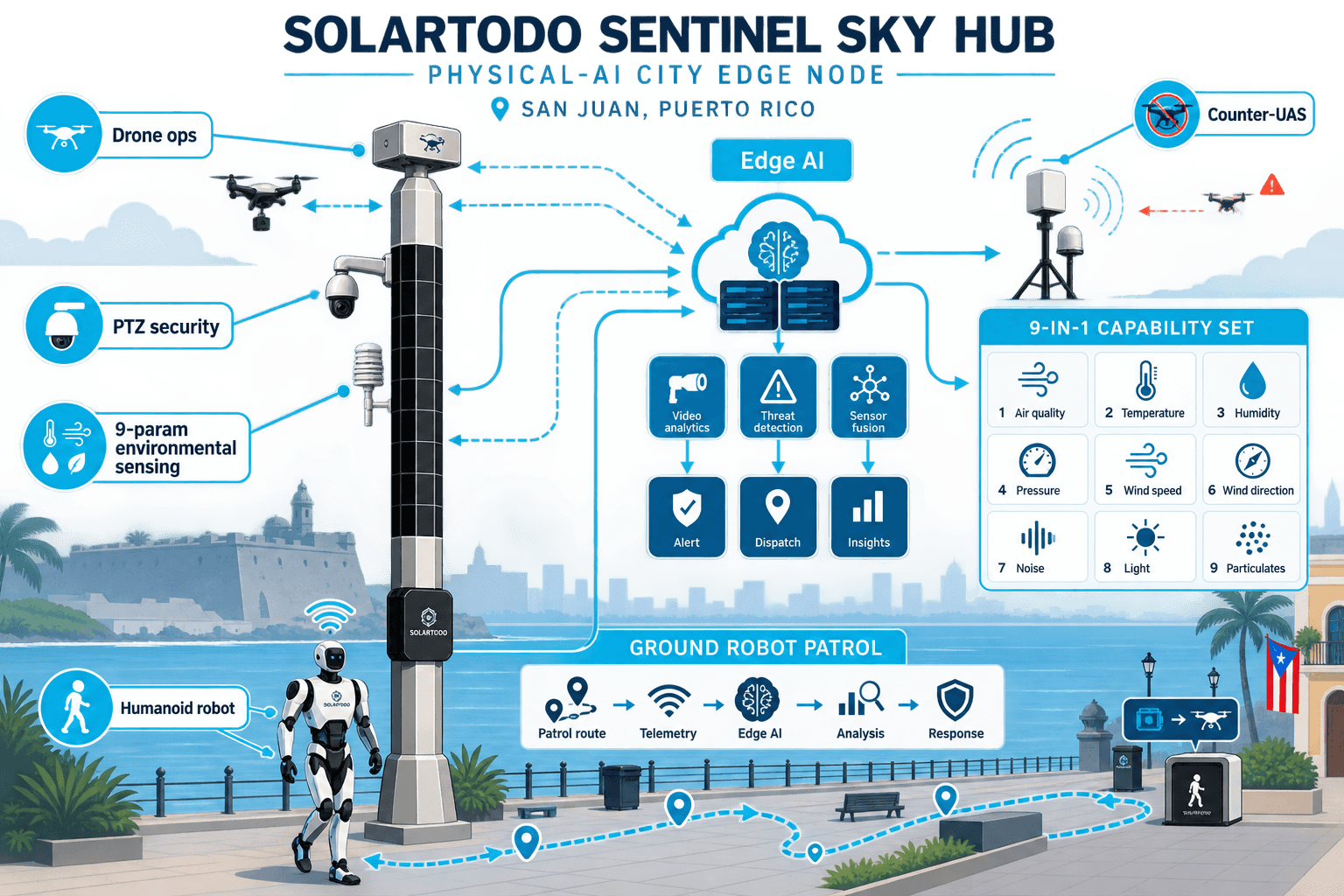
- Environmental sensing: wind speed, wind direction, temperature, humidity, atmospheric pressure, noise, PM10, PM2.5, and illuminance.
- Security analytics: anonymous vehicle count, crowd density, intrusion detection, and perimeter awareness; no active face recognition or licence-plate recognition claim.
- Drone operations: autonomous launch, patrol, inspection, return, task queueing, mission logs, and automated multi-bay battery exchange.
- Ground robot operations: patrol, inspection, alarm response, air-ground coordination, and return-to-base wireless charging.
- C-UAS coordination: detection and tracking with human-authorized soft aerial net-capture or close-approach deterrence; no jamming, weapons, shoot-down, or autonomous attack.
- Optional inputs: partner radar or other external sensors may feed the command view, but radar is not pole hardware.
- Standards alignment: design review should reference IEC 60529 enclosure protection, NEC/NESC safety practice, Puerto Rico Codes, LUMA/PREPA interface rules where relevant, and municipal permit requirements.
Implementation Approach
A 104-node San Juan rollout would typically need 5 work phases: survey, permitting, procurement, civil installation, and commissioning with acceptance tests.
Phase 1 should define the operating map. Engineers would validate the 104 candidate points against flood maps, drainage inlets, port and traffic constraints, communications coverage, wind exposure, municipal right-of-way ownership, and utility conflicts. In Old San Juan and La Puntilla-style locations, ground works may need heritage-sensitive procedures and tighter excavation limits.
Phase 2 should convert the concept into a bid-ready technical package. According to LUMA (2026), Puerto Rico grid design work references utility standards, NEC, NESC, Puerto Rico Codes, and OGPe permitting practice for applicable electrical work. Even though the SOLARTODO node is off-grid, these local references matter for grounding, clearances from utility assets, construction safety, and coordination when poles sit near distribution corridors.
Phase 3 is supply-chain planning. A practical route would use containerized ocean freight to Puerto Rico, followed by staged local delivery to avoid blocking narrow city streets. CKD or modular shipment can reduce site handling risk, but each package should preserve factory-tested energy, compute, communications, and drone-service subsystems.
Phase 4 is foundation and pole erection. Civil crews would complete layout, excavation, rebar, concrete, anchor verification, pole setting, cabinet sealing checks, and drainage protection. Waterfront and back-bay locations should receive added attention to corrosion, wind loading, splash exposure, and post-storm access for inspection.
Phase 5 is commissioning. Each pole should pass power-buffer tests, solar replenishment checks, sensor calibration, local inference validation, mission queue tests, robot charging checks, drone battery exchange tests, and command-view integration. The acceptance protocol should also prove that raw video remains local and that exported data is limited to de-identified event or status metadata.
Expected Performance & ROI
A 104-node off-grid edge network can reduce trenching exposure, preserve grid capacity, and concentrate inspection resources on approximately 4.16 km of priority corridors.
The economic case in San Juan is resilience and operating substitution, not electricity resale. Avoided trenching, fewer grid interconnection studies, reduced manual patrol hours, faster post-storm inspection, and better event triage are the relevant benefits. According to EIA (2026), Puerto Rico’s power prices rank among the highest U.S. jurisdictions, so avoiding continuous utility load is commercially meaningful even when the pole’s solar layer is only replenishment.
A realistic ROI model should treat payback as scenario-based. For a 104-node configuration, public owners would compare EPC cost against patrol labor, incident response time, temporary generator use, truck rolls, storm-recovery inspection delays, and avoided raw-video backhaul storage. For dense civic or port-adjacent corridors, a 5-8 year payback model is plausible if the system replaces recurring manual inspection routes and improves response utilization; final payback depends on local labor rates, maintenance contract scope, and duty cycle.
NIST states, “The Privacy Framework is a voluntary tool” for managing privacy risk, which supports a local-processing architecture in public-space deployments. SOLARTODO’s recommended privacy posture for San Juan is PDPL-LGPD-oriented by design: process raw streams locally, minimize retention, export only de-identified metadata, and keep human authorization in the response workflow. This is a design orientation, not a claim of certification.
Results and Impact
The expected impact is a 104-node, approximately 4.16 km city-edge layer for sensing, inspection, environmental data, and authorized response coordination.
For San Juan, the most defensible impact metric is operational coverage rather than a fabricated case-study outcome. A 104-node network can create a repeatable edge layer across selected municipal corridors, allowing command staff to view anonymized activity, weather, air quality, device health, drone status, and robot availability in one common operating picture. The value is especially relevant before and after heavy rain events, when road access and manual inspection capacity are constrained.
The configuration also improves procurement clarity. Instead of buying separate poles, cameras, environmental stations, drone docks, robot chargers, edge servers, and backup power boxes, the SOLARTODO Sentinel City AI Pole packages them as a single off-grid node with defined interfaces. That reduces integration ambiguity, but it does not remove the need for site engineering, permits, civil works, operator training, and maintenance planning.
Comparison Table
A San Juan buyer should compare 104 off-grid AI poles against grid-tied camera poles and separate drone docks using power, data, maintenance, and flood-resilience criteria.
| Evaluation factor | SOLARTODO Sentinel City AI Pole | Grid-tied camera pole | Separate drone dock plus sensors |
|---|---|---|---|
| Typical San Juan quantity | 104 nodes | 104+ poles/cabinets | 104 sensor points plus fewer docks |
| Spacing assumption | ~40 m | ~40 m | Sensors ~40 m, docks site-dependent |
| Power model | Fully off-grid, 5-20 kWh storage | Utility service required | Usually site power or dedicated service |
| Solar role | 1.0-1.3 kW DC-class clear-sky replenishment | Usually none | Often auxiliary only |
| Raw video handling | Stays on pole | Often backhauled to VMS | Varies by integrator |
| Drone service | Integrated launch and battery exchange | Not included | Included only at dock sites |
| Robot service | Base charging and task coordination | Not included | Usually separate integration |
| C-UAS posture | Human-authorized, non-lethal coordination | Detection only if added | Varies; avoid jamming or hard-kill claims |
| San Juan fit | High for flood-prone, off-grid corridors | Moderate where power is reliable | High for limited nodes, lower for continuous corridors |
Pricing & Quotation
SOLARTODO offers 3 pricing tiers for the SOLARTODO Sentinel City AI Pole product line, including supply-only, delivered, and EPC turnkey scopes.
SOLARTODO offers three pricing tiers for this product line: FOB Supply (equipment ex-works China), CIF Delivered (including ocean freight and insurance), and EPC Turnkey (fully installed, commissioned, with 1-year warranty). Volume discounts are available for large-scale deployments. Configure your system online for an instant estimate, or request a custom quotation from our engineering team at [email protected].
For San Juan, quotation scope should define corrosion class, wind criteria, foundation assumptions, communications backhaul, training, spares, drone/robot duty cycle, software integration, and acceptance tests. Buyers evaluating the SOLARTODO solutions portfolio should request a line-item matrix that separates pole hardware, energy storage, aerial operations, robotic operations, civil works, commissioning, and maintenance.
Frequently Asked Questions
A San Juan buyer should answer at least 10 technical, commercial, installation, maintenance, warranty, and ROI questions before approving a 104-node configuration.
Q1: Is the SOLARTODO Sentinel City AI Pole a smart streetlight? No. The SOLARTODO Sentinel City AI Pole is a pure smart pole with no lighting system. It is designed for edge AI, sensing, drone operations, robot operations, environmental monitoring, and human-authorized response coordination. Procurement documents should avoid lamp, luminaire, or streetlight language so reviewers evaluate the correct product category.
Q2: Why is an off-grid pole useful in San Juan? San Juan has coastal flood exposure and an island grid with high fuel dependence. A fully off-grid node avoids new utility service for each pole and keeps sensing available through battery buffering. The on-pole solar layer replenishes storage, but high-power drone and robot workflows still require duty-cycle planning.
Q3: What is the recommended deployment size? The recommended market-analysis configuration is approximately 104 nodes at about 40 m spacing, equal to roughly 4.16 km of priority corridor coverage. Final node count should be confirmed by survey, flood mapping, communications testing, wind loading review, right-of-way limits, and municipal permitting constraints.
Q4: How long would installation typically take? A 104-node San Juan rollout would normally be phased rather than installed all at once. A practical schedule includes survey and permitting, factory configuration, ocean freight, foundation works, pole erection, commissioning, and operator training. The actual timeline depends on procurement rules, port logistics, traffic control, and heritage-sensitive locations.
Q5: What maintenance is required in coastal Puerto Rico? Maintenance should include corrosion inspection, seal checks, battery health review, solar surface cleaning, sensor calibration, drone battery magazine testing, robot charging verification, firmware updates, and event-log audits. Waterfront and back-bay locations should receive shorter inspection intervals after tropical storms, heavy rain, or salt-spray exposure.
Q6: What data leaves the pole? Raw video and sensor streams should remain on the pole for local processing. Only de-identified event metadata, equipment status, alarms, and mission logs should leave the node. This supports a PDPL-LGPD-oriented privacy design and reduces bandwidth, storage, and public-space data governance risk.
Q7: Does the system include counter-drone capability? Yes, but only as non-lethal, human-authorized coordination. The pole can detect and track an unauthorized drone and command a friendly drone for soft aerial net-capture or close-approach deterrence. It must not be specified for jamming, shoot-down, autonomous attack, weapons, or destructive interception.
Q8: What ROI period should San Juan planners model? A defensible model should compare capital and maintenance cost against patrol labor, truck rolls, temporary generator use, post-storm inspection time, storage/backhaul cost, and avoided utility service work. For dense civic corridors, a 5-8 year planning window is reasonable, but final payback depends on duty cycle and labor assumptions.
Q9: How does this compare with camera-only poles? Camera-only poles can provide video coverage but usually require site power, network cabinets, separate analytics, and separate maintenance contracts. The SOLARTODO Sentinel City AI Pole integrates local compute, environmental sensing, drone service, robot charging, battery storage, and response coordination in one off-grid edge node.
Q10: How should EPC pricing be requested? Request three scopes: FOB Supply, CIF Delivered, and EPC Turnkey. For San Juan, the EPC quote should include foundations, corrosion assumptions, commissioning, training, spares, warranty, communications, local permits, and acceptance testing. Use contact us for a custom engineering quotation without publishing budget-sensitive project details.
Q11: What warranty should be expected? The standard EPC Turnkey paragraph specifies a 1-year warranty. Buyers should clarify battery warranty terms, consumables, drone-service components, robot charging interfaces, sensor calibration, corrosion exclusions, hurricane damage assumptions, and response times. Long-term service can be contracted separately after the first-year acceptance period.
Q12: What local standards should engineering teams consider? Engineering review should consider Puerto Rico Codes, OGPe permitting, NEC/NESC safety practice, LUMA/PREPA interface requirements near utility assets, IEC 60529 enclosure protection, and applicable municipal right-of-way rules. Because the pole is off-grid, utility interconnection is generally not the core design issue, but clearance and safety coordination still matter.
References
These 7 references anchor the San Juan analysis in public statistics, climate records, flood studies, procurement rules, energy context, and technical standards.
- U.S. Census Bureau (2025): QuickFacts reports San Juan municipio’s estimated 2025 population at 329,737 and 2020 Census population at 342,259.
- National Weather Service San Juan (2026): 2025 climate report lists 81.7°F mean temperature, 75 days at or above 90°F, and 68.86 inches of precipitation.
- U.S. Energy Information Administration (2026): Puerto Rico consumes almost 80 times more energy than it produces; 2025 fossil-fuel plants provided 93% of electric generating capacity.
- LUMA Energy (2026): Engineering standards and bulletins identify current Puerto Rico T&D design references, including distribution standards, NEC/NESC, Puerto Rico Codes, and utility construction guidance.
- U.S. Army Corps of Engineers (2021): San Juan Metro Back Bay Coastal Storm Risk Management study addresses coastal flooding from storm surge, tides, waves, and sea level change.
- Government of Puerto Rico / Justia (2024): Municipal procurement law requires public bidding above $100,000 for goods and above $200,000 for public works, with notice requirements.
- IEC (2013): IEC 60529 defines enclosure ingress-protection classification for electrical equipment up to 72.5 kV rated voltage.
Equipment Deployed
- 104 SOLARTODO Sentinel City AI Pole Sky Hub nodes, project-based custom configuration
- 5-20 kWh-class battery storage per node with on-pole solar replenishment
- Jetson-class edge AI compute for local inference and workload scheduling
- PTZ sensing package for anonymous vehicle count, crowd density, intrusion, and perimeter awareness
- Nine-parameter environmental monitoring: wind speed, wind direction, temperature, humidity, pressure, noise, PM10, PM2.5, illuminance
- Autonomous drone launch, patrol, return, mission queue, and multi-bay battery exchange subsystem
- Ground robot operations interface with patrol, response, inspection, and wireless charging at pole base
- Human-authorized, non-lethal C-UAS coordination with optional partner-sensor input