Summary
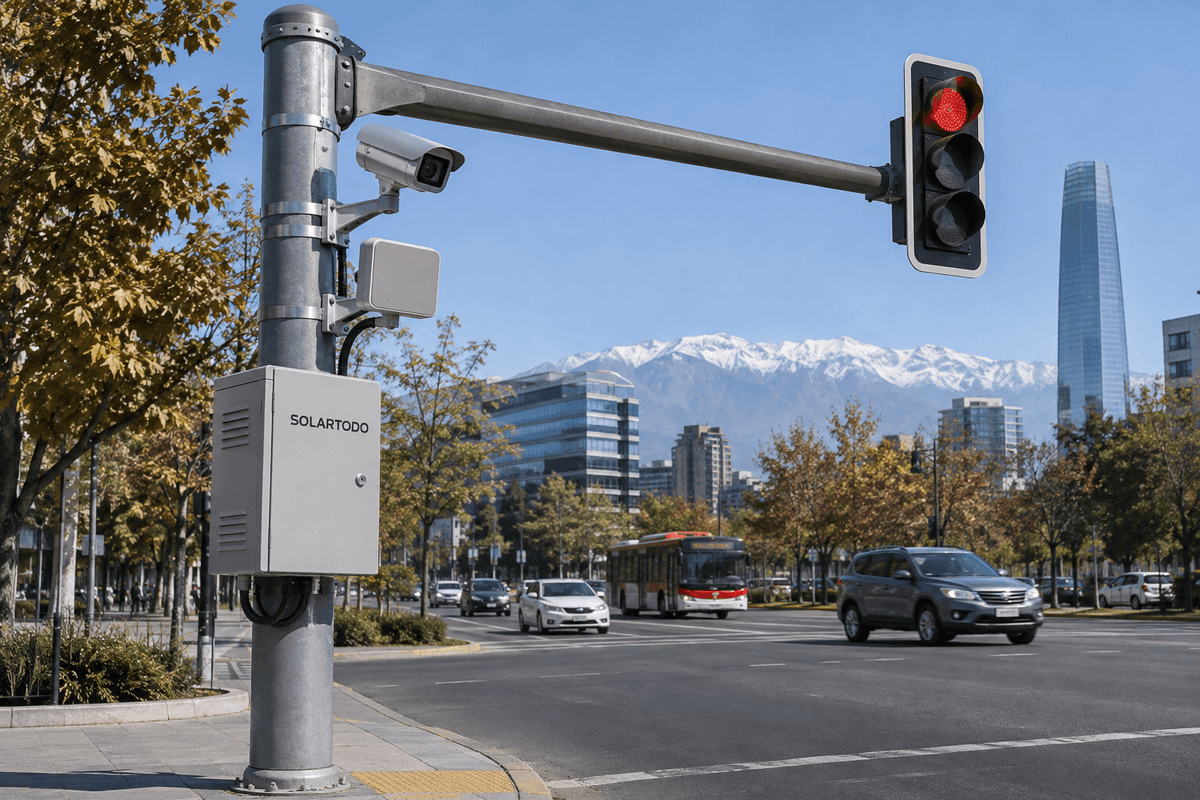
Signal-command authority should reside in the signal controller that drives the intersection displays. The proposed SOLARTODO pole-side equipment should supply observations through its perception and edge processing functions. If the project later proposes a write interface, the edge may submit a documented request within an approved scope, and the controller should decide whether and when to execute it. Enable timing changes only after the selected interface demonstrates which commands are permitted, which checks run at the controller, and how the buyer can verify that the intended timing actually took effect. Santiago, Chile, is solely a proposed evaluation site. The supplied evidence establishes the product family’s catalog scope. It is insufficient to approve a model-specific write interface or to qualify an installation.
Key Takeaways
- Assign execution authority and responsibility for the signal displays to the controller in the proposed design.
- Start with observation and read-only evaluation while the selected equipment and interface are documented.
- Ask for a command register that identifies permitted requests, valid parameters, eligible modes, and rejection behavior.
- Require tests showing that the controller checks requests before applying them and retains control when requests fail.
- Match each approved request to controller execution records and observable signal output before signing off on writes.
- Make configuration-specific documentation and witnessed acceptance evidence procurement conditions for enabling timing changes.
Proposed problem
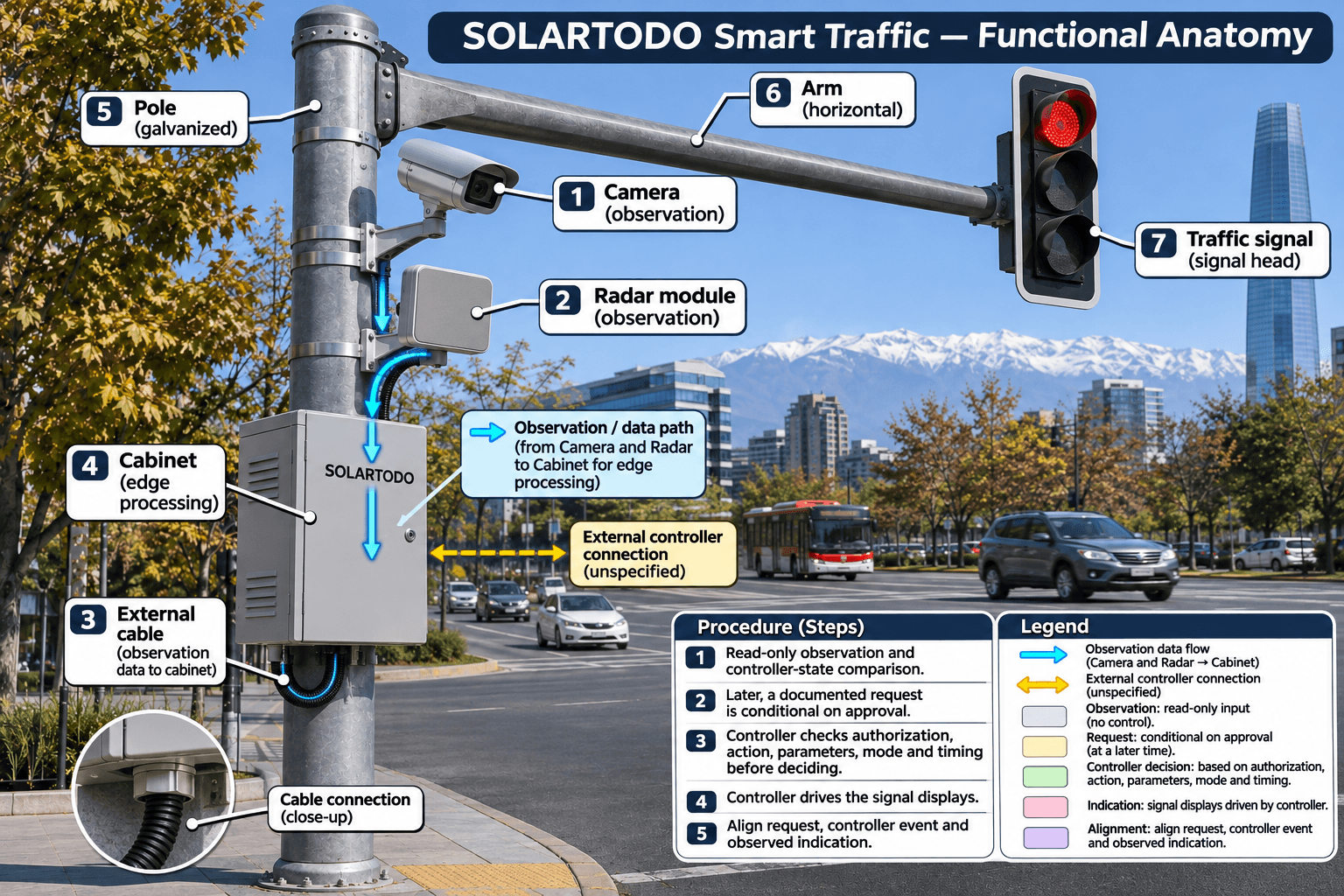
The buyer needs to decide where a traffic observation can become an authorized timing change. A camera or radar observation may feed the proposed edge processing layer. Any conclusion drawn from that observation is an input to the proposed control process. The controller should remain responsible for turning an eligible request into a change in the timing that drives the displays. This allocation gives the buyer a clear place to inspect authorization, timing constraints, mode restrictions, and execution records. The FHWA Adaptive Signal Control FAQs describe a signal controller as the device that executes signal control logic to control intersection displays. That definition informs the proposed split. FHWA Adaptive Signal Control FAQs
The acceptance question arises when an edge system reports that a request was sent or when an interface returns an acknowledgment. The supplied evidence does not define what a send report or an acknowledgment means for the selected interface. The buyer still needs controller-side evidence that the requested action was applied to the intended controller and timing context, at the transition the controller allowed, with the expected signal output. Without that trace, the buyer cannot distinguish receipt from execution, or an executed request from an unrelated timing change.
Source-backed product boundary
The supplied SOLARTODO catalog extraction, identified as city-catalog-2026-11-01-v1, covers smart traffic equipment combining a traffic pole, camera, radar, signal equipment, and edge processing. It places pole geometry, dimensions, sensor selection, and signal interfaces at the selected-configuration level. Those catalog terms are the basis for the equipment list and the extent of the supported product description here. See the SOLARTODO smart traffic product page and the public SOLARTODO catalog route.
The evidence pack contains no product PDF or PDF URL, and gives no model identifier, PDF page, or model-specific operating conditions. Consequently, a PDF citation with page and model context cannot be supplied, and there is no basis to specify a controller interface, permissible commands, or operating envelope as a SOLARTODO product fact. During procurement, request the selected model’s product PDF and the applicable interface documentation. Use the PDF as the authority for product descriptions where sources differ, and tie the acceptance plan to the model, pages, and conditions documented for the offer.
Proposed design
For the proposed Santiago evaluation, place observation and interpretation on the pole side. Document what information the selected configuration can provide, how it represents missing or stale observations, and which parts of the configuration produce each record. In the read-only stage, the evaluator can compare pole-side observations with reference observations and align them with controller state records where those records are available. This stage lets the buyer inspect the usefulness of the inputs while the controller continues to execute its configured logic.
For any later write stage, require the supplier to document the proposed request path through to the controller. The command register should specify the requested action, its allowed parameters, the intended controller or configuration scope, the caller that may submit it, the operating modes in which it is eligible, and the expected response. For a proposed timing request, ask when it can take effect, what happens while it waits, and when it expires. A buyer reviewing a command should be able to tell what change the controller is being asked to apply and under what conditions the request becomes ineligible.
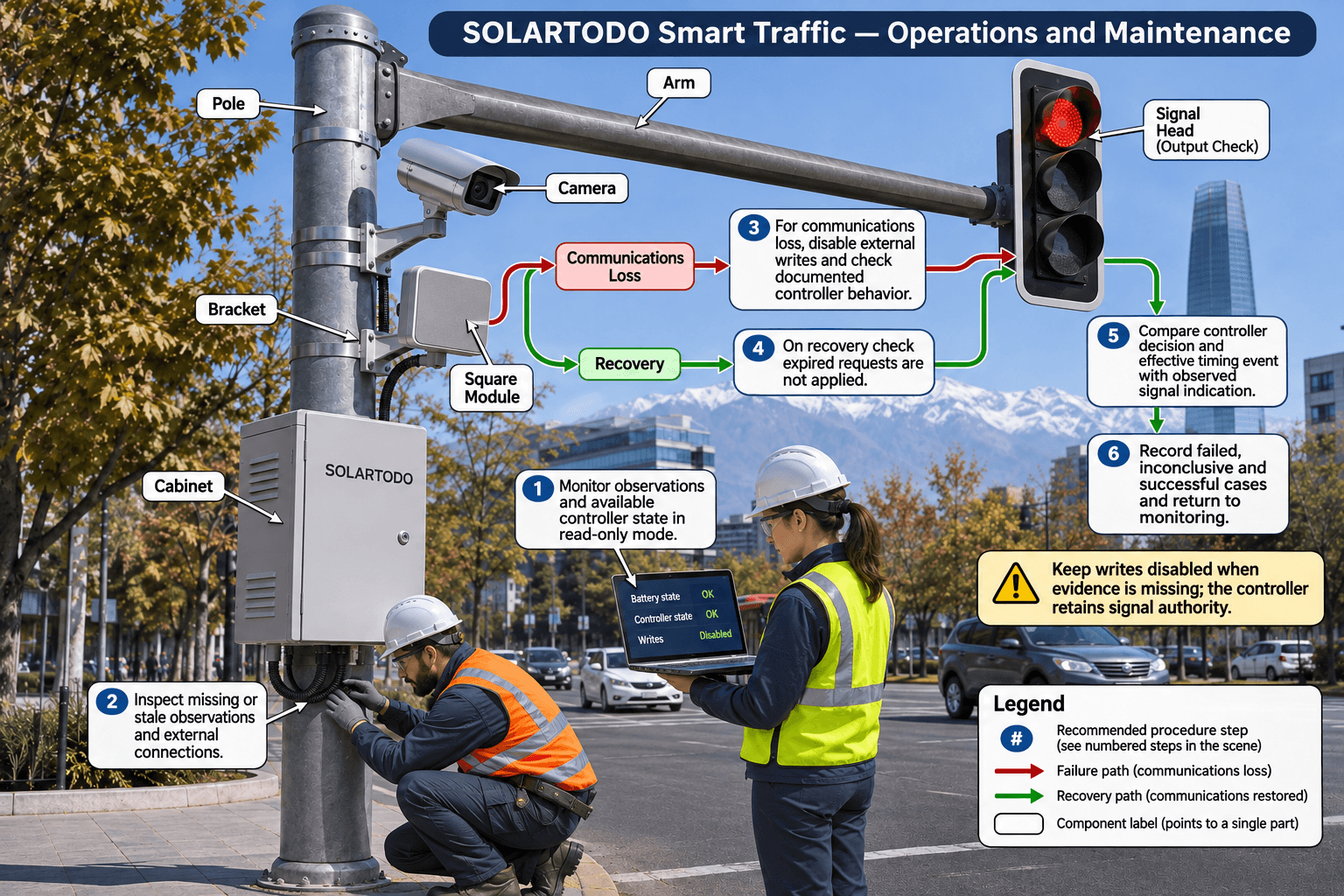
Require the selected interface to demonstrate controller-side checks for authorized callers, permitted actions, parameter bounds, applicability in the current operating mode, and timing or phase constraints relevant to the requested action. Request a documented policy for stale requests, repeated submissions, conflicting requests, and communications loss. The documentation should identify who can disable external writes and describe how the controller behaves after write access is disabled and when communications return. Use witnessed tests to check those behaviors against the documented configuration.
Build the acceptance trace around the same request throughout. Record what the edge submitted, how the controller evaluated it, and what timing or phase event the controller recorded when it applied the change. Correlate that record with observed signal indications in the agreed test setup. Agree on a common time reference or another documented means of aligning the records. If the controller defers a request, capture both the deferral and its eventual disposition. If it rejects the request, capture the reason and check the relevant controller and output records for effects attributable to that request. The supplier should show how those distinctions appear in the available records for the selected interface.
Explicitly hypothetical measurable evaluation assumptions
The following are candidate acceptance criteria for an agreed test set. They express proposed thresholds for buyer review and carry no model-specific performance claim.
- Hypothetical evaluation assumption: Every eligible write request in the agreed test set can be matched to a controller decision, the intended effective timing or phase event, and the corresponding observed signal indication.
- Hypothetical evaluation assumption: Every prohibited or out-of-bounds request in the agreed test set is rejected with a recorded reason and causes no attributable timing change.
- Hypothetical evaluation assumption: Every deferred request in the agreed test set has a trace that identifies when it was deferred and whether it was subsequently applied, rejected, or expired.
- Hypothetical evaluation assumption: Every documented communications-loss and recovery case in the agreed test set produces the controller behavior specified for that case, with no expired request applied after recovery.
Record the tested operating mode, initial controller state, expected event, observed event, and evidence location for each case. Have the buyer and supplier agree on how they will count attempted, deferred, rejected, expired, and executed requests. Retain the records for failed and inconclusive cases alongside the successful ones. This allows a reviewer to see whether the test exercised a controller decision and whether the records support the conclusion drawn from it.
Survey and acceptance checklist
- Survey the proposed site. Identify the candidate intersection, the responsible operator, the existing controller and its configuration, available state and event records, and the path through which a proposed interface would connect. Check which signal indications can be observed and associated with controller records in the chosen test setup.
- Identify the offered configuration. Capture the SOLARTODO model and revision, the selected pole and sensors, the signal equipment, and the applicable interface documents. Record the source page and operating conditions for each model-specific claim used in the acceptance plan.
- Review the interface before connecting writes. Verify the command register, the authorization scheme, the scope of controller-side checks, the meaning of each response, and the documented behavior during loss and restoration of communications.
- Witness valid and invalid requests. Exercise permitted requests in eligible modes and requests that should be refused because of their permissions, values, age, or operating context. Include repeated submissions and requests that must wait for a permitted transition where those cases are relevant to the selected interface.
- Inspect the actual output. For executed requests, compare the effective controller event and observed signal indication with the intended change. For rejected or expired requests, review the relevant controller and output records to determine whether any effect can be attributed to the request.
- Review approval evidence. Record which commands and conditions were witnessed and which cases remain unresolved. Limit any approval to the tested commands and documented conditions. Keep writes disabled while essential authority, validation, or execution evidence is missing.
Limitations
The catalog establishes a family scope. It supplies no basis for claiming compatibility with a particular Santiago controller, certification, approval, detection accuracy, communications latency, collision reduction, or operating performance. The proposed site still needs a survey. The article makes no claim about a Santiago installation, local traffic demand, or local climate.
Interface acceptance addresses whether the system can request and execute a defined change under agreed conditions. An evaluation of traffic outcomes would need its own operational objective, baseline, measures, and suitable data. FHWA Chapter 1 distinguishes verification of procured features from validation against operational objectives. That U.S. guidance provides methodological context for organizing the evaluation and carries no regulatory authority for the proposed Santiago site. FHWA Measures of Effectiveness and Validation Guidance, Chapter 1
Procurement questions
- Which offered model and document revisions define the equipment, operating conditions, and controller interface? Which pages cover the claims in the offer?
- Which requests can the offered interface submit, and which configuration items or timing parameters can each request affect?
- Which checks run in the controller, and what records show that the checks were applied before execution?
- What does each response mean, and which record proves that a request became effective at the intended transition?
- How can the operator disable writes, determine the resulting controller state, and review what happens at recovery?
- Which test records, controller exports, and observed output evidence will the supplier deliver for buyer review?
FAQ
Where should signal-command authority reside?
It should reside in the signal controller that executes control logic and drives the displays. The proposed edge layer may submit documented requests if writes are approved.
What can the buyer evaluate before enabling writes?
The buyer can evaluate pole-side observations and compare them with reference observations and available controller state records in a read-only stage.
What should the permitted command register include?
It should describe each action, its allowed parameters and scope, the caller authorized to submit it, eligible controller modes, and the expected response.
Which checks belong at the controller?
Require evidence that the controller checks caller authorization, permitted actions, parameter bounds, current operating mode, and any applicable timing or phase constraints before execution.
Does an acknowledgment prove a timing change took effect?
The supplied evidence does not establish what an acknowledgment means for the selected interface. To prove execution, match the request to the controller’s effective timing or phase event and corroborate it with observed signal output.
How should communications loss and recovery be evaluated?
Witness the documented controller behavior during loss and recovery, and check that expired requests are never applied after communications return in the agreed test cases.
Is a model-specific product PDF available in the evidence pack?
The pack contains no product PDF or PDF URL and gives no model, PDF page, or model-specific operating conditions. Request those records for the offered configuration before technical sign-off.
Does successful interface acceptance demonstrate a traffic benefit?
Interface acceptance demonstrates the tested request and execution behavior. Traffic benefits require a separate evaluation with an operational objective, baseline, measures, and suitable data.
References
- SOLARTODO smart traffic catalog, supplied extraction identified as
city-catalog-2026-11-01-v1. Public product catalog - U.S. Federal Highway Administration, Adaptive Signal Control FAQs, including the definition of a signal controller. Adaptive Signal Control FAQs
- U.S. Federal Highway Administration, Chapter 1 of Measures of Effectiveness and Validation Guidance for Adaptive Signal Control Technologies, for verification and validation methodology. Chapter 1
Proposed Equipment
- Traffic pole
- Camera
- Radar
- Signal equipment
- Edge processing