Summary
Hold the proposed shared mounting assembly for clarification until configuration-specific structural evidence is available. Use that evidence to decide whether to accept the offered arrangement or request redesign; missing documentation alone does not establish a design defect.
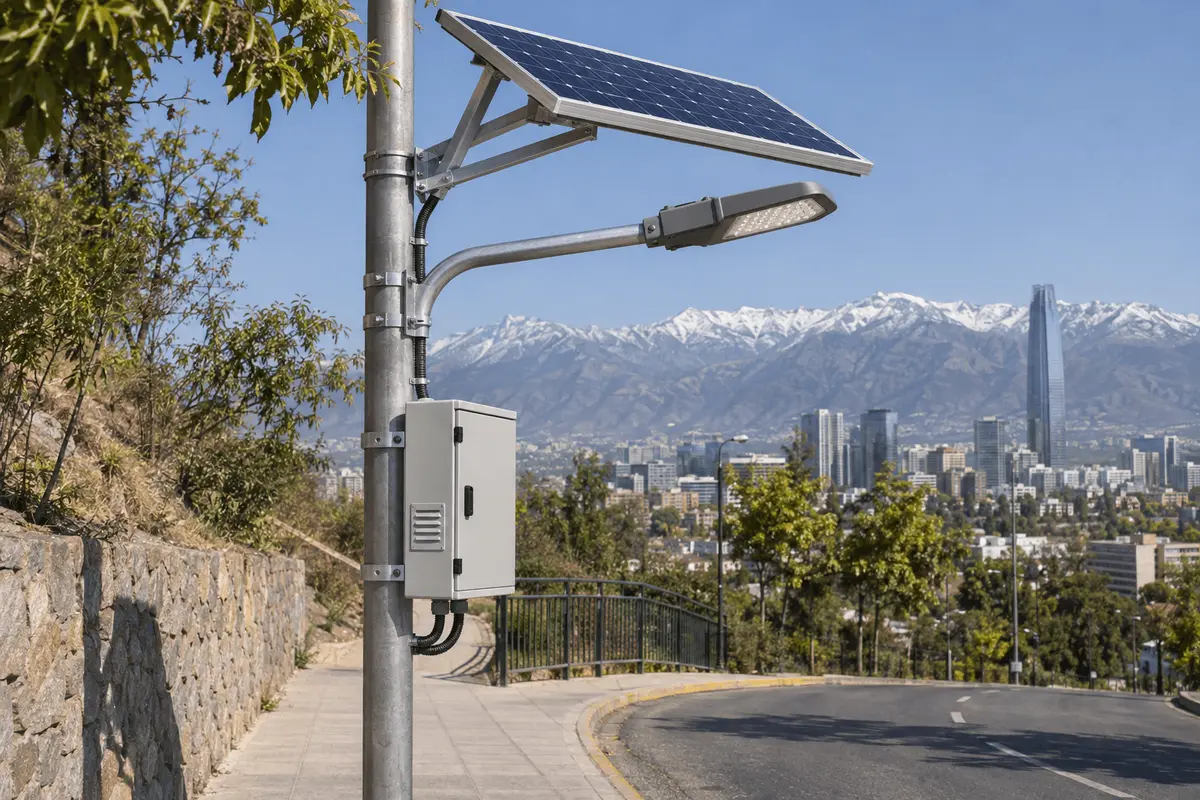
Santiago is a proposed site only. The supplied SOLARTODO catalog describes a possible split arrangement with a tilted module above a side-arm LED and a separate battery enclosure. It does not establish that these components can share a particular structure. Request an identified configuration, separately established site inputs, and an assessment addressing support and resistance to wind, rain, hail, and corrosion.
Key Takeaways
- Obtain a component schedule and drawing identifying the exact proposed arrangement.
- Assign a project designer to establish site requirements and document the basis for the assessment.
- Request configuration-specific evidence addressing the module, side arm, enclosure, attachments, and selected support together.
- Ask suppliers to identify the components, conditions, and exclusions covered by environmental evidence.
- Refer discrepancies and substitutions to the responsible designer for a documented decision.
- Hold unresolved submissions; consider acceptance or redesign according to the assessment findings and agreed project criteria.
FAQ
Can the proposed components share one mounting structure?
The supplied sources do not establish this for a selected assembly. Request a configuration-specific assessment addressing the proposed components, attachments, and support before deciding.
What should the buyer request first?
Request an identified component schedule and assembly drawing showing module tilt, side-arm offset, enclosure location, attachments, and documented physical inputs. Ask the designer to identify any additional information needed.
Who should prepare the structural assessment?
Assign a responsible structural designer through the project. Request an assessment identifying its author, scope, configuration, design inputs, limitations, and findings. The supplied sources do not establish Chilean qualification or approval requirements.
What if the offered configuration differs from the assessment?
Hold the affected submission and ask the responsible designer for a documented decision on the difference. Request updated drawings or assessment documents where that decision calls for them.
Does the supplied evidence include a module or assembly test?
No module or assembly test report is supplied. If one is offered later, request its model identification, tested configuration, conditions, results, and exclusions before relying on it for the proposed arrangement.
When should the buyer request redesign?
Request redesign when the configuration-specific assessment identifies changes needed to meet the established project criteria. Where evidence is missing, seek substantiation before deciding whether changes are necessary.
What product authority is available?
The supplied authority is the SOLARTODO solar-streetlighting catalog, identity city-catalog-2026-11-01-v1. No selected model or product PDF is supplied. Request exact model identification, document revision, applicable pages, and stated conditions for any later product-specific submission.
What energy-selection information does the catalog require?
The catalog requires coordinated selection of module area, battery capacity, fixture power, mounting structure, and control profile using site solar-resource and load data. It establishes no fixed backup-night duration or energy-saving percentage for an unconfigured site.
The buying decision
The buyer is considering whether a tilted module, side-arm LED luminaire, and separate battery enclosure can share a selected mounting structure. The catalog establishes this as a possible split arrangement, but supplies no configuration-specific structural assessment.
Use the following proposed procurement decisions, subject to the project's agreed criteria:
- Hold: request missing configuration information, site inputs, or assessment evidence, and seek resolution of open findings.
- Consider acceptance: review a documented assessment of the identified configuration against the established project criteria, together with the agreed installation records.
- Request redesign and reassessment: act on assessment findings that identify necessary changes, then request corresponding revisions before reconsidering the submission.
These are proposed purchasing steps. They do not establish product ratings, local approval requirements, or an engineering finding about this assembly.
Product scope and source authority
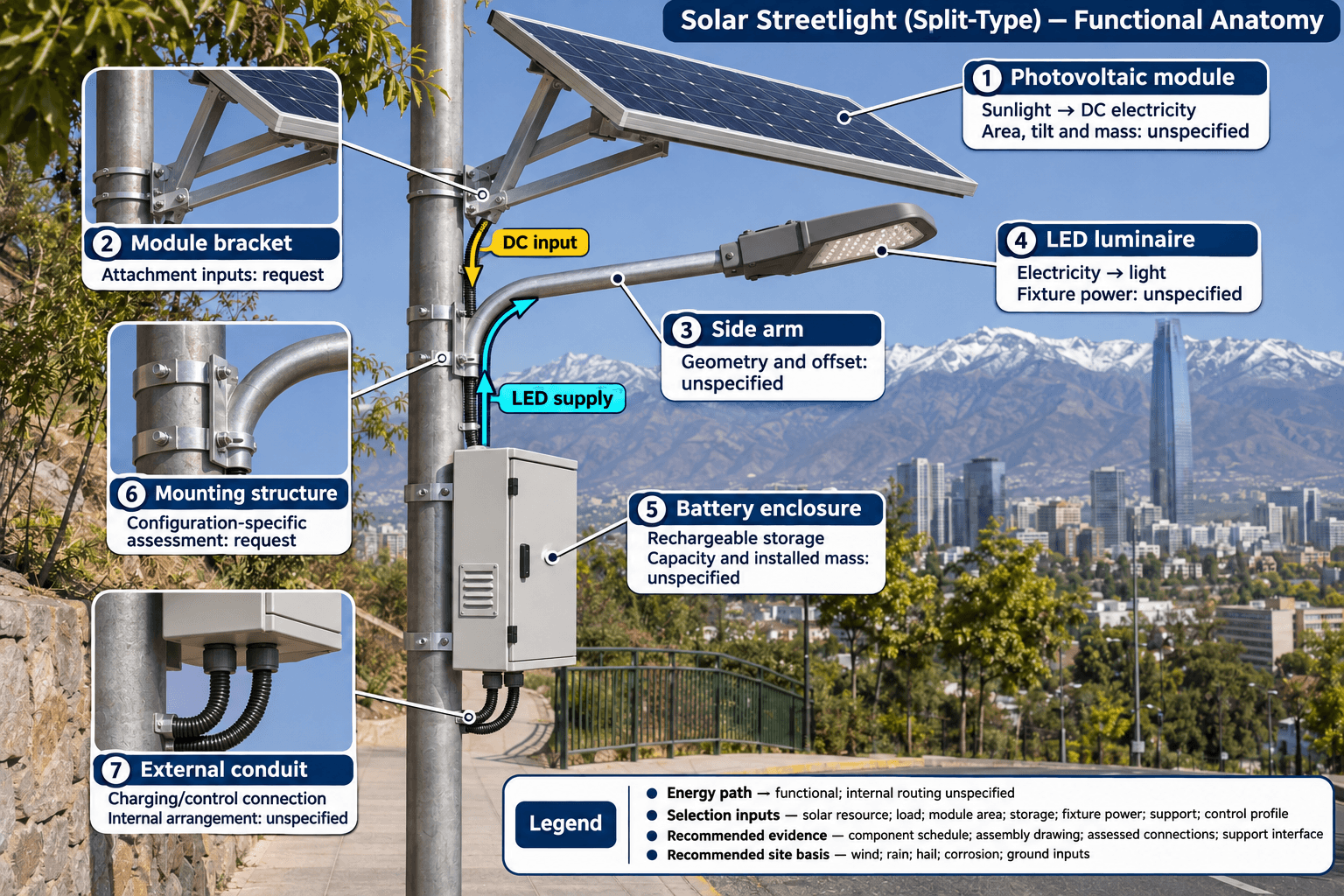
The SOLARTODO solar-streetlight catalog, identity city-catalog-2026-11-01-v1, includes photovoltaic modules, rechargeable battery storage, an LED luminaire, and charging/control equipment. It describes a possible split arrangement with a tilted module above the side-arm LED and a separate battery enclosure. The solar-streetlight product page provides product navigation.
The catalog requires coordinated selection of module area, battery capacity, fixture power, mounting structure, and control profile using site solar-resource and load data. For this procurement, request one configuration identifier across the proposed equipment schedule, energy-selection submission, drawings, and structural assessment so the buyer can compare the documents.
No selected model, mounting dimensions, material specification, structural capacity, environmental test report, certification, operating envelope, or product PDF is supplied. Request these details where relevant to the project assessment. For any later product-specific document, retain the exact model, revision, applicable pages, and stated conditions, and ask the supplier to resolve conflicting descriptions.
The supplied DOE photovoltaic guidance states that PV mounting structures must support the array and withstand wind, rain, hail, and corrosion. It supplies general mounting context; it contains no qualification of the proposed SOLARTODO assembly.
Define the proposed assembly
Request a configuration identifier linked to a component schedule and assembly drawing. Ask the responsible designer to confirm which physical inputs are needed, including:
- Module dimensions, exposed area, tilt, mass, center of gravity, and attachment locations.
- Side-arm geometry, luminaire position, masses, and offsets.
- Battery enclosure dimensions, installed mass, position, and attachments.
- Brackets, fasteners, supporting materials, and proposed support or foundation interfaces.
- Charging/control equipment locations where the designer considers them relevant to the assessment.
These are proposed information requests, not specifications established by the catalog. Request documented physical inputs rather than treating electrical ratings as substitutes for the information requested by the designer.
Establish the site basis separately
Santiago is solely the proposed location. The supplied sources provide no site-specific wind, rain, hail, corrosion, or ground-design inputs for this proposal.
Ask the project designer to document the applicable requirements, environmental inputs, support assumptions, and sources used. Request a list of unresolved inputs and an explanation of which decisions must remain open until those inputs are established. No local loads, exposure classifications, foundation conditions, or approval procedures are asserted here.
For module geometry, request the project's proposed orientation and tilt and ask that the assessment identify the geometry it addresses. DOE discusses tilt in relation to latitude, structure orientation, and electrical load requirements. Its due-south orientation example expressly concerns the northern hemisphere; it is not a Santiago installation instruction.
Request configuration-specific structural evidence
The following is a proposed submission scope for the responsible designer to confirm and supplement. The supplied sources do not establish a complete engineering checklist or a locally sufficient approval package.
Components, connections, and support
Ask the designer to assess whether the identified structure can support the proposed arrangement under the established project criteria. Request an explanation of the assessed load paths, connection assumptions, support interfaces, and resistance evidence. No particular load path or connection performance is established by the supplied catalog.
Ask the assessment to identify the drawings and physical inputs used, the checks performed, the criteria applied, and any findings requiring clarification or changes. Where installation details or restrictions form part of the assessment, request that they be recorded in the corresponding supply and installation documents.
Wind, rain, hail, and corrosion
DOE identifies these exposures in its general mounting guidance. For the proposed procurement, ask the designer to define the evidence needed for each established project exposure:
- Wind: request calculations or relevant test records identifying the assessed geometry, attachments, and support assumptions.
- Rain: request details addressing the water-exposure questions identified by the designer, including drainage and penetrations where applicable.
- Hail: request any relevant test records with component identification, test conditions, acceptance criteria, and results.
- Corrosion: request material and protective-finish specifications, interface details, and any relevant maintenance conditions for the designer's review.
For every record, ask which proposed components it covers and which remain unaddressed. No environmental test result or service-life guarantee for this assembly is supplied.
Close the submission with documented decisions
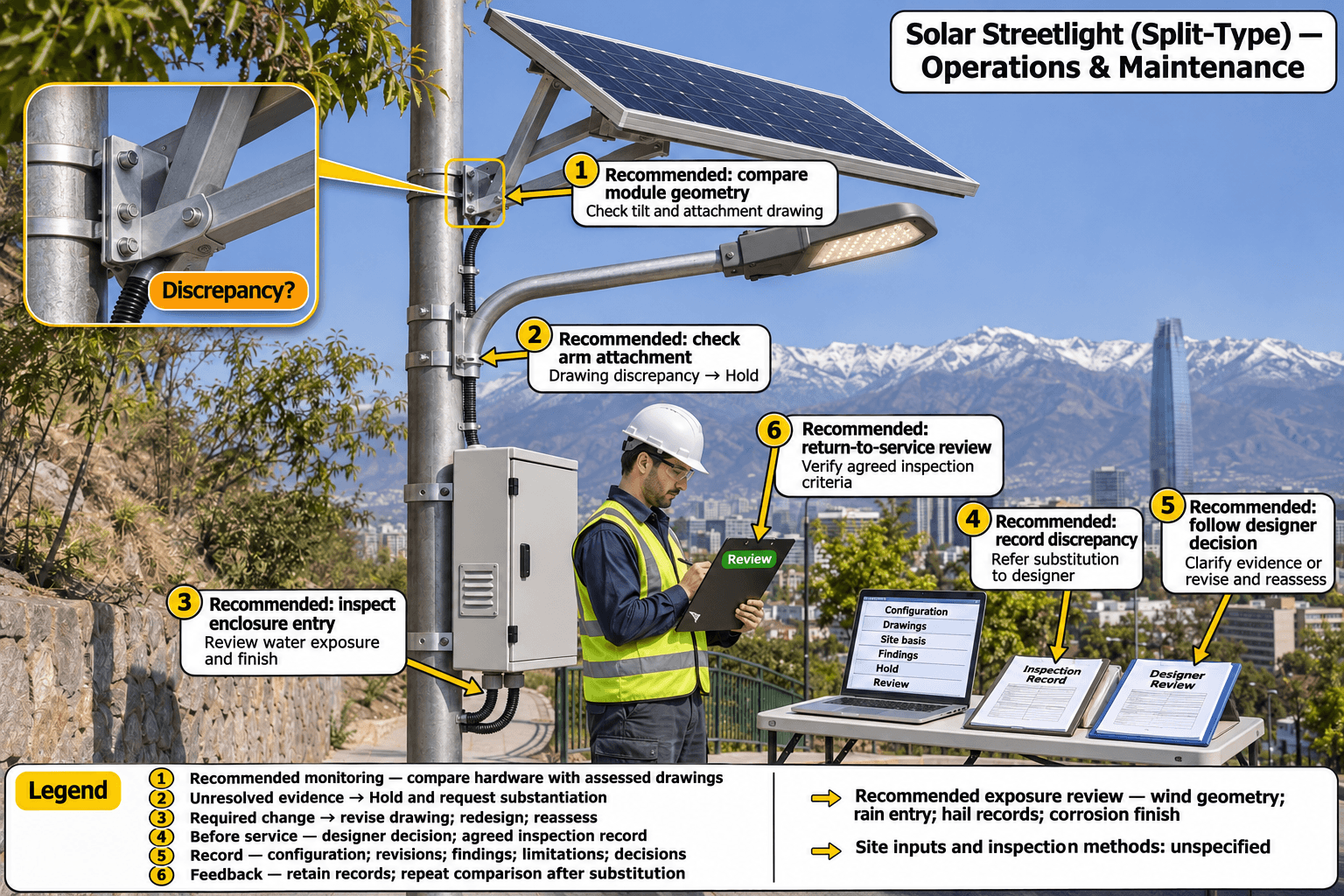
Agree responsibilities and closing criteria with the project. A practical submission register can use these proposed entries:
- Configuration: ask the supplier for the component schedule, drawings, physical inputs, and stated attachment restrictions; request designer confirmation of the configuration assessed.
- Site basis: ask the project designer for the requirements, environmental inputs, support assumptions, and unresolved questions.
- Structural assessment: request the identified assessment, its limitations, findings, and documented decisions on required changes.
- Environmental evidence: request relevant records and details, with a designer's explanation of their applicability and remaining gaps.
- Installation records: agree inspection scope, methods, responsibilities, and acceptance criteria with the designer; request records against those agreed criteria.
- Changes: ask the supplier to identify substitutions and drawing discrepancies, and request a documented designer decision before closing the affected submission.
Do not treat this register as evidence that an inspection has occurred or that the assembly meets the project criteria. Retain the configuration identifier, document revisions, assessment findings, decisions, and agreed installation records for the buyer's acceptance review.
Coordinate the remaining purchasing evidence
Alongside the structural submission, request the coordinated equipment selection described by the catalog, using site solar-resource and load data. The supplied material establishes no measured lighting performance, local deployment, customer result, fixed autonomy, or energy-saving percentage for this proposal.
The supplied FEMP exterior-lighting guidance recommends gathering relevant information on product performance, cost, and reliability when making purchasing decisions. Its acquisition requirements concern U.S. federal procurement. The supplied material does not establish those requirements as applicable to this Santiago proposal, or establish FEMP designation for the offered SOLARTODO equipment.
References
- SOLARTODO solar-streetlight catalog: supplied catalog identity city-catalog-2026-11-01-v1. Establishes product-family scope, a possible split arrangement, and coordinated selection requirements; supplies no selected model or product PDF.
- U.S. DOE: Solar Photovoltaic System Design Basics: general PV mounting and environmental-resistance context. Its due-south orientation example concerns the northern hemisphere; it does not assess this proposed assembly.
- U.S. DOE FEMP: Purchasing Energy-Efficient Exterior Lighting: U.S. federal acquisition guidance and purchasing context concerning performance, cost, and reliability; supplies no qualification of this proposed system.
Proposed Equipment
- Photovoltaic modules
- Rechargeable battery storage
- LED luminaire
- Charging/control equipment
- Mounting structure for the proposed split arrangement
- Side arm for the LED luminaire
- Separate battery enclosure