Summary
Ask bidders to price a single-tenant steel monopole and a separately priced design with a defined second-tenant equipment allowance. Buy the reserve only after the engineer verifies the combined layouts against the same site design basis and demonstrates that the monopole, connections, and foundation can carry the governing loads and meet serviceability criteria. Santiago, Chile, is solely the proposed project location. The evidence supports a comparison and procurement decision process. It is insufficient to approve a reserve, select a specific model, or release a design for construction.
Key Takeaways
- Issue the same site design basis to bidders for both options so the reserve price reflects a comparable scope.
- Draw candidate antenna and radio layouts before asking for a capacity figure. Include mounting elevations, orientations, and equipment offsets.
- Ask the engineer to compare opening-day loading with full shared occupancy and plausible asymmetric arrangements.
- Require the foundation designer to check reactions from the governing pole cases against parcel-specific ground information.
- Express the purchased reserve as a checked equipment and mounting envelope linked to drawings and calculations.
- Require a layout review before the future operator installs equipment or changes its mounting arrangement.
Proposed problem
The buyer must decide whether to pay now for a structure and foundation designed for a future second operator. The single-tenant option is the baseline for serving the opening tenant. The reserve option must serve that same tenant at opening and support a particular future arrangement after the second tenant arrives. Ask bidders to show what must be installed at opening, what can be added later, and what would need replacement or reinforcement under the baseline if shared occupancy proceeds.
The value of reserve depends on how clearly the buyer can describe the future installation. A candidate equipment schedule can be useful before a second operator is selected if it defines allowable placements and loading inputs tightly enough for an engineer to test. If the future layout is still too uncertain to bound, price the engineering and construction options separately and defer the reserve commitment. The GSMA handbook describes passive infrastructure sharing as a commercial arrangement and provides context for evaluating site sharing. The commercial decision for this parcel needs its own evidence. Infrastructure sharing
Source-backed product boundary
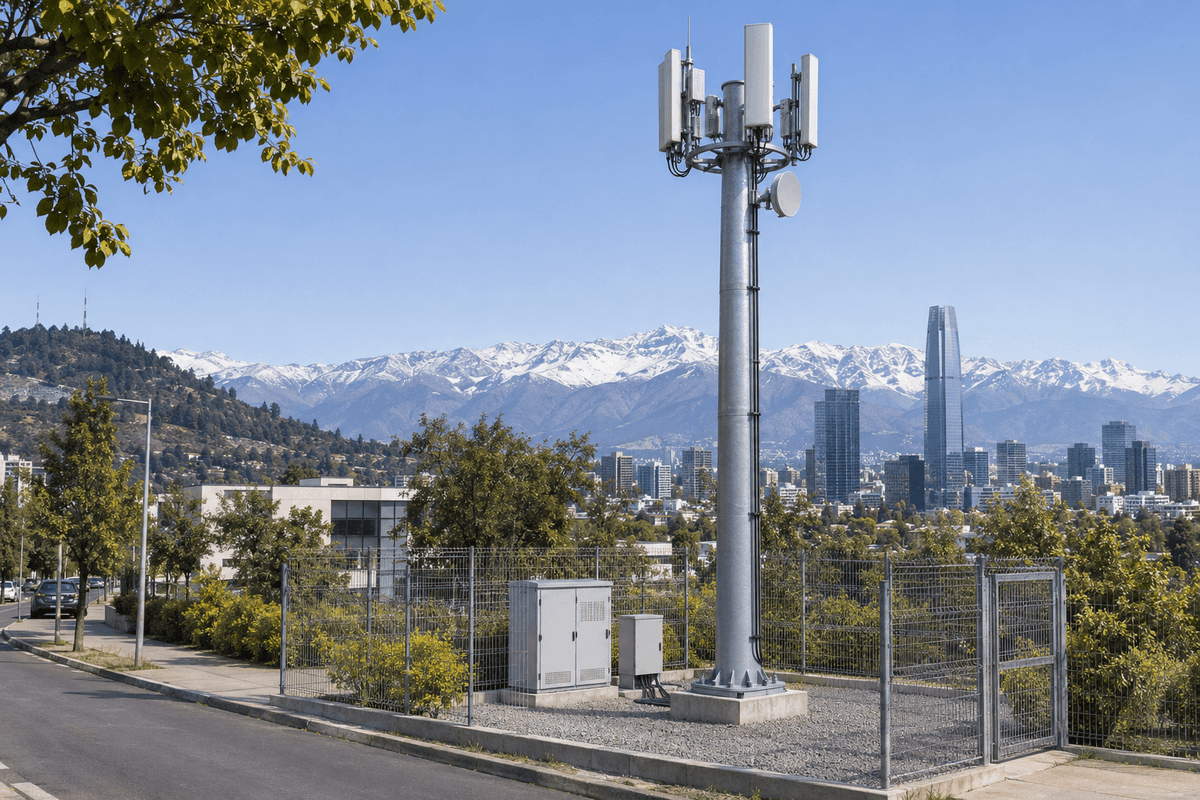
The SOLARTODO telecom-tower catalog, identified in the supplied record as city-catalog-2026-11-01-v1, includes a steel monopole as a selectable tower form. This evaluation uses the tubular steel monopole from that product family. The catalog treats antennas, radios, and backhaul equipment as configuration items. It calls for project-specific verification of wind loading, antenna loading, height, foundation, corrosion protection, and aviation or planning considerations. It establishes no universal tower weight per metre, load capacity, or coverage radius. SOLARTODO telecom-tower catalog
Use the SOLARTODO telecom tower product page to identify the product family in the inquiry. The supplied pack contains no product PDF, PDF URL, page reference, model identifier, or model-specific operating conditions. Those details remain unverified and the PDF reference is unavailable. Require bidders to identify the offered model and cite the technical PDF pages and operating conditions used in their design. Use that PDF as the authority for model-specific product facts and reconcile it with the bid drawings before accepting an equipment schedule.
Proposed design
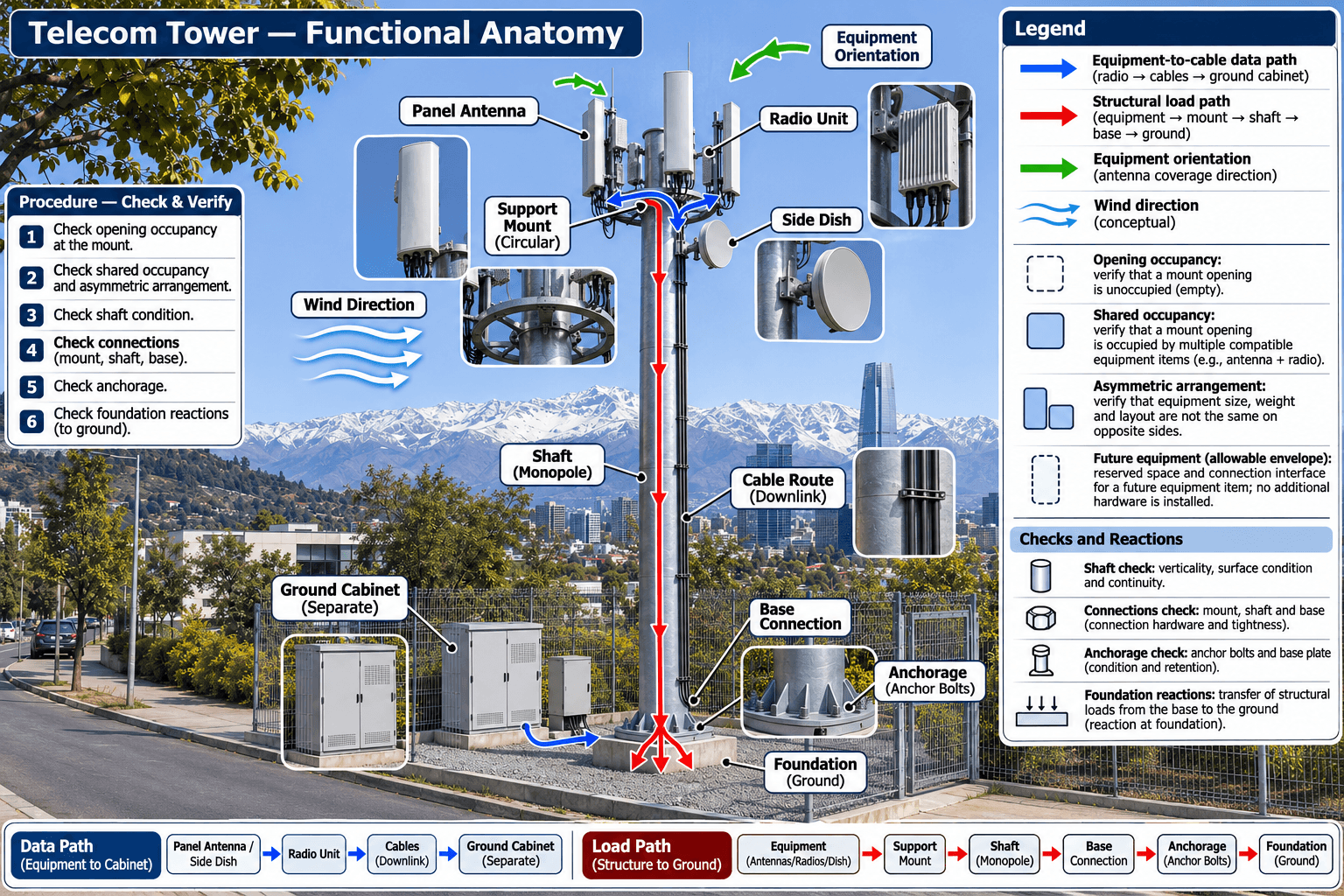
Start with a common layout schedule. Ask the opening tenant for candidate antenna and radio positions, then prepare a candidate future layout that shows where the second operator could mount its equipment. For each item, record its mass, wind-area data and basis, mounting elevation, orientation, offset from the shaft, and the supporting hardware proposed for it. Include the loads from candidate backhaul equipment, mounts, and cable routes wherever they are in scope. Identify who supplies each input and which revision of the equipment drawing it came from.
For the single-tenant design, check the opening tenant's full candidate installation on the baseline monopole. For the design with reserve, check opening-day occupancy on the offered reserve structure, including any future-tenant mounts or hardware installed from the outset. Then check full shared occupancy with both equipment inventories and all relevant supports in place. Keep opening-tenant service needs and the site design basis consistent across bids. If a bidder changes the opening layout to make room for the second operator, have the opening operator review the revised positions and record the change alongside the bid comparison.
Have the engineer evaluate wind direction against equipment orientation and mounting geometry. Combine the pole's wind actions with those from the equipment and supports, account for equipment weight and eccentricity, and apply the load combinations established for the project. Evaluate credible asymmetric placements and partial installation states within the proposed envelope where they can govern. Record the controlling arrangement and wind direction for each relevant response. Ask the engineer to identify any additional actions, combinations, and installation-stage checks required by the applicable project design basis.
Check the shaft and its connections for the applicable axial, bending, shear, and torsional effects. Review the proposed mounts, shaft connections, base connection, and anchorage along the load path. Document deflection and twist at equipment mounting levels against criteria agreed with the operators. Send concurrent axial force, shear, overturning moments, and torsion from the governing cases to the foundation designer. Check the foundation and anchorage against the actual geotechnical design inputs, with bearing, sliding, overturning, uplift, and movement addressed as applicable. Carry the controlling load-case identifiers through to both sets of calculations so the buyer can trace the foundation design back to the equipment arrangement.
Explicitly hypothetical measurable evaluation assumptions
Hypothetical evaluation assumption: The buyer requests a side-by-side comparison of the baseline opening layout, the reserve design at opening, and the reserve design at full shared occupancy.
Hypothetical evaluation assumption: The engineer records demand-to-capacity ratios for applicable strength checks and identifies the governing load case for each reported ratio.
Hypothetical evaluation assumption: The engineer reports calculated lateral displacement and twist at each candidate antenna mounting elevation and compares them with operator-supplied limits.
Hypothetical evaluation assumption: The foundation comparison records the governing concurrent reaction sets and shows the calculated demand against the applicable acceptance criterion for each foundation check.
Hypothetical evaluation assumption: The commercial comparison records the quoted incremental upfront price of the reserve option and separately identifies the scope and estimated cost of later work under each option.
Survey and acceptance checklist
- Establish the parcel. Confirm coordinates and ground levels at the proposed work location, identify property boundaries and constraints, and document access for construction and future equipment installation. Use parcel-level information to establish exposure and obtain the site wind design inputs.
- Obtain foundation inputs. Commission the ground investigation needed for the proposed design and confirm who interprets it for foundation sizing. Check that the foundation calculations cite the same soil inputs, siting, and reaction schedules used in the design review.
- Review approvals locally. Assign responsibility for confirming which planning and aviation reviews apply and capturing their effect on the offered design. The FAA source illustrates a U.S. obstruction evaluation process. Establish the Santiago approval path with the competent local authorities. FAA Obstruction Evaluation Overview
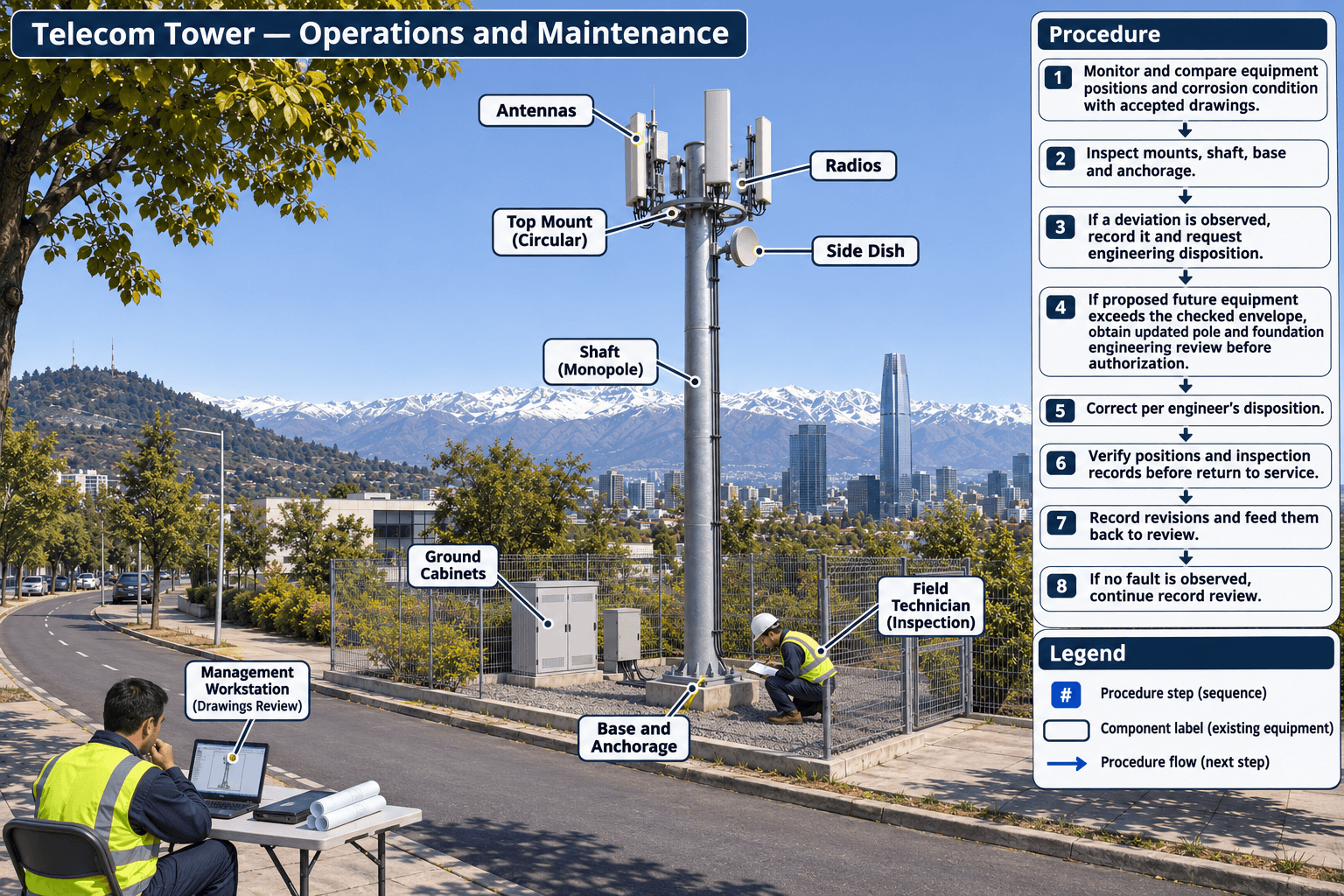
- Reconcile drawings and calculations. Review matching revisions of the equipment register, mounting elevations, load-case matrix, pole calculations, foundation calculations, and corrosion-protection specification. Resolve any differences in equipment weights, wind inputs, mounting offsets, or base reactions before accepting the offer.
- Inspect the installed work. Compare the installed pole, anchorage, mounts, corrosion protection, and opening-day equipment positions with the accepted drawings and inspection records. Record deviations and obtain an engineering disposition where a change could affect the accepted loading envelope.
- Preserve a record for the future tenant. Retain the accepted layouts, calculations, inspection records, and limits on future equipment. Require the new operator's actual equipment and installation drawings to be checked against that record before authorizing installation.
Limitations
The evidence pack supplies no parcel survey, geotechnical report, wind design inputs, or operator equipment schedules. It also supplies no assessed pole or foundation response for any layout. The relative cost and feasibility of the two options therefore remain open. Structural acceptance addresses the supported equipment and its load path. The supplied evidence contains no site-specific coverage or backhaul performance assessment. Obtain locally applicable design criteria and approval information before using the comparison to set contractual requirements.
Procurement questions
Ask each bidder to explain precisely what the reserve buys. Which equipment positions and combinations are covered? What limits apply to mass, wind area, orientation, and offsets at those positions? Can the stated maxima occur together, and which layouts govern if placement changes? Which components must be installed at opening, and which may be supplied later? Request a revision-controlled equipment schedule and drawings so the quoted allowance can be compared across offers.
Ask which engineer owns the interface between pole and foundation design and how design revisions will update both calculations. Request separate prices for the baseline and the reserve, plus an itemized scope of later work for each. Clarify who reviews substitutions, who pays for engineering if the future layout falls outside the checked envelope, and what access or interruption the later installation could entail. Approve the premium when the documented future layout passes the engineering checks and the buyer can justify the upfront cost against the priced implications of deferral.
FAQ
Should the initial design include a second-operator reserve?
Buy a reserve only when a defined future equipment layout passes the pole and foundation checks and the buyer can justify the quoted premium.
What should the candidate equipment schedule contain?
Record each antenna, radio, and applicable backhaul item with its mass, wind-area basis, mounting elevation, orientation, offset, and supporting hardware.
Which combined loading cases should the engineer verify?
Check the baseline opening layout, the reserve design at opening, full shared occupancy, and credible asymmetric or partial arrangements that could govern under the project load combinations.
Why does the foundation need its own verification?
The foundation designer must use concurrent reactions from the governing pole cases and check them against parcel-specific ground inputs and the proposed foundation and anchorage.
How should the procurement documents express the reserve?
Tie the allowance to a revision-controlled equipment schedule and drawings that define allowable positions, masses, wind areas, orientations, offsets, and combinations.
What local information is needed before accepting either design?
Obtain parcel and access survey information, verified wind design inputs, ground investigation results, and a determination of applicable local planning and aviation reviews.
Does the supplied catalog identify a specific monopole model or rating?
The supplied catalog identifies the steel monopole product family. Ask the bidder for the offered model and supporting PDF pages and operating conditions.
What happens when the second operator proposes different equipment?
Compare the actual equipment and mounting drawings with the accepted envelope and obtain an updated engineering check for changes outside it before authorizing installation.
References
- SOLARTODO telecom-tower product catalog. The supplied extraction identifies
city-catalog-2026-11-01-v1and supports the steel monopole and configurable equipment scope. Product PDF, model, pages, and operating conditions were absent from the supplied evidence. SOLARTODO telecom-tower catalog - GSMA Mobile Policy Handbook, Business Environment. The Infrastructure Sharing and Passive Infrastructure Providers sections provide context on commercial sharing arrangements. GSMA handbook
- U.S. Federal Aviation Administration, Obstruction Evaluation Overview. Foreign-jurisdiction context for aeronautical review of proposed structures. FAA overview
Proposed Equipment
- Tubular steel monopole
- Antennas
- Radios
- Backhaul equipment