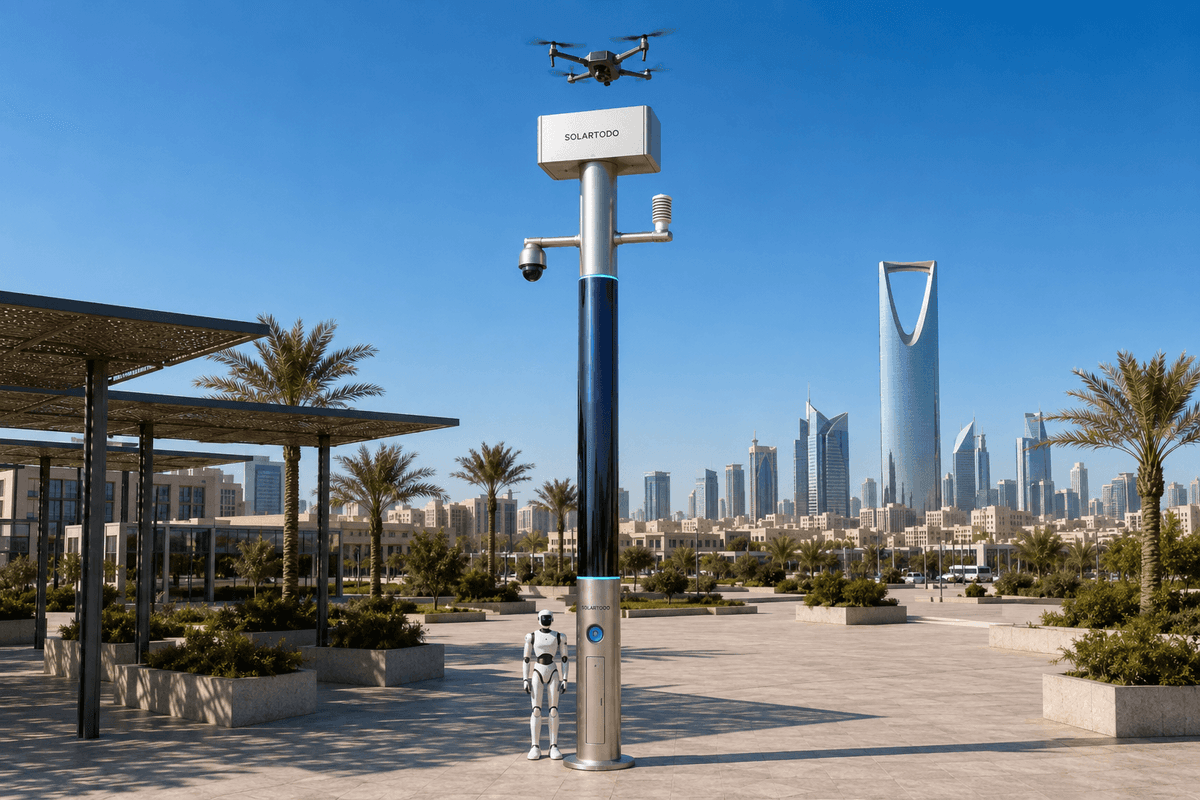
A City AI Pole is a non-lighting physical-AI edge node that combines off-grid energy storage, edge compute, sensing, drone operations and robot operations in one pole-form urban asset. In this Singapore transport-hub case, SOLARTODO Sentinel Sky Hub supports low-altitude inspection by locally processing PTZ camera and environmental data, coordinating battery-swapped drone sorties, and sharing de-identified event metadata with city operators.
Procurement Context: Singapore Transport Hubs Under Event Pressure
Singapore’s transport hubs sit at the center of dense passenger movement, airport and rail connections, port-adjacent logistics, waterfront destinations, and event-driven crowd surges. During a major sports event, the city-management problem is not simply to add more cameras or more patrol staff. The practical requirement is to maintain a live operating view across perimeter roads, pedestrian approaches, service lanes, loading areas, temporary crowd-control barriers, and low-altitude airspace near sensitive venues, without adding grid dependency or creating a new lighting asset to maintain.
This procurement case frames SOLARTODO Sentinel Sky Hub as a proposed, illustrative configuration for a Singapore transport-hub environment, subject to final engineering confirmation. The buyer is a city-management stakeholder evaluating how a grid-mesh of physical-AI urban edge nodes can shorten response-time targets for low-altitude inspection during sports-event peaks. The selected archetype is transport-hub because the operating pattern is mixed: public movement, controlled service access, vehicle circulation, security perimeters, rooflines, station canopies, and nearby open corridors all change in intensity across the day.
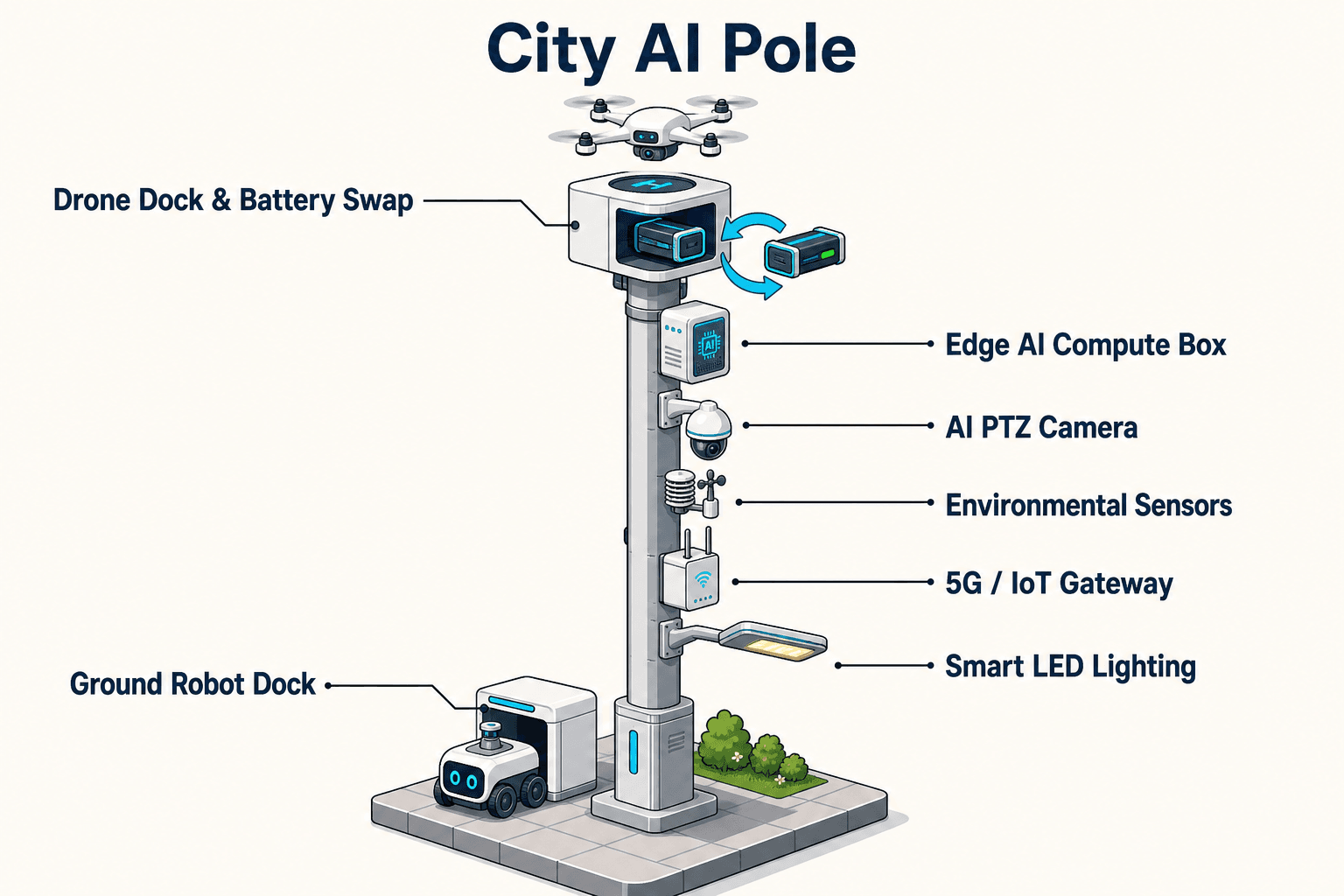
The core pain point is drone endurance. A single drone sortie can inspect a route, but frequent return-to-charge cycles create gaps in coverage. Manual battery handling also introduces dependency on an on-site operator, which is hard to sustain during long event windows and late-night demobilization. Sky Hub addresses this by placing autonomous drone launch, landing, battery hot-swap, local perception, edge scheduling, and ground robot return-to-charge functions at the pole. The pole is a pure smart pole: it is not a smart streetlight, includes no lighting system, and is not positioned as an illumination upgrade.
The procurement question is therefore operational: can city management place off-grid, battery-backed edge nodes where inspection tasks recur, then evaluate response-time improvements through a common operating picture without centralizing raw video? The proposed answer is a grid-mesh deployment pattern, where multiple Sky Hub nodes divide low-altitude inspection routes, share de-identified status and event metadata, and allow operators to authorize response workflows from a single command view.
Proposed Grid-Mesh Configuration
The proposed Singapore configuration uses Sky Hub as a pole-form physical-AI edge node installed at selected transport-hub perimeter points: arrivals and service-road approaches, pedestrian choke points, controlled access gates, roofline inspection viewpoints, utility corridors, and event overlay zones. No specific site quantity or coverage area is assumed in this case. A final deployment layout would depend on local survey, sky-view access, shading, wind exposure, drone flight permissions, pedestrian clearance, maintenance access, and stakeholder operating rules.
Each node carries a vertical cylindrical body of about eight meters in height and about 0.6 meters in width, wrapped with approximately fifteen square meters of flexible CIGS thin-film solar. The wrap is rated at roughly 2.4 to 2.7 kWp nameplate, but the realistic operating model is deliberately conservative. Because a vertical cylinder collects direct sun mainly on the sun-facing projection rather than across the full wrap at once, clear-sky peak output in a high-irradiance reference region is roughly 0.8 to 1.1 kW DC, with daily generation typically in the single-digit kWh range. In Singapore, tropical cloud, rain, haze, urban canyon shading, and station canopy shadows must be modeled before duty cycles are finalized.
For procurement purposes, the solar layer should be treated as supplemental replenishment for a fully off-grid, battery-backed micro-station, not as an unlimited pure-solar promise. The high-power work, including drone launch cycles, automated battery exchange, edge inference, PTZ patrol, environmental sensing, and robot charging, is buffered by storage in the 5 to 20 kWh class. OTATODO schedules tasks according to available stored energy, mission priority, weather, queue state, and maintenance windows.
The grid-mesh mode matters because no single pole needs to carry every task continuously. A node near a service entrance may prioritize perimeter awareness and rapid drone relaunch. Another node near a pedestrian surge point may prioritize PTZ-based crowd density estimates and environmental monitoring. A third node near a roofline inspection corridor may queue drone sorties after rainfall or after temporary structures are installed. Together, the mesh gives city management a distributed inspection fabric with local processing at the edge.
Battery-Swap Drone Endurance for Low-Altitude Inspection
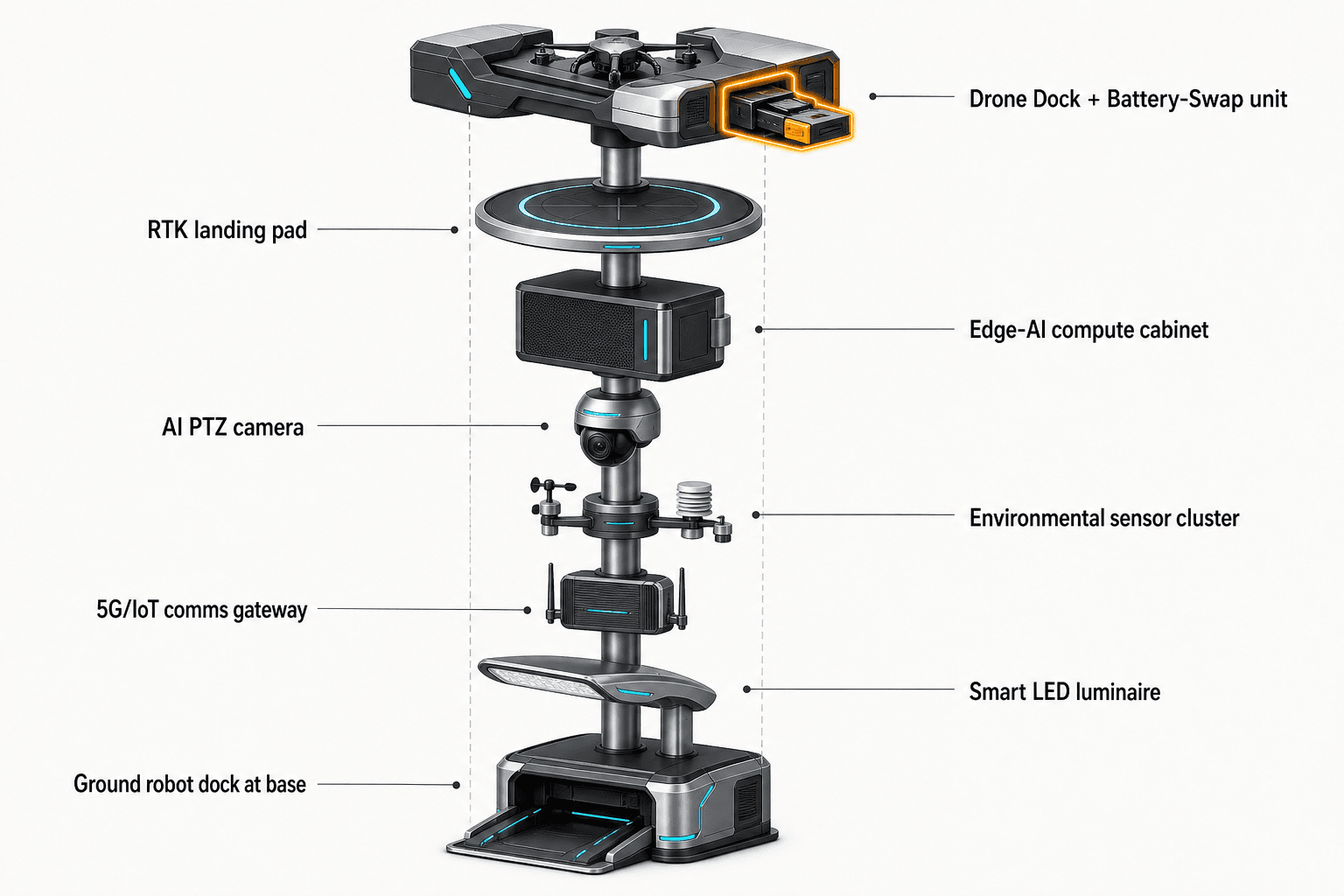
The procurement focus is battery-swap because endurance is the limiting factor for repeated low-altitude inspection. In this case, a Sky Hub node supports launch, regional patrol, inspection, return, automated battery exchange, and task redeployment without a pilot or battery technician standing at the pole. After landing, the drone enters a rear-service exchange workflow: a multi-bay battery magazine removes the depleted pack, inserts a charged pack, confirms state, and releases the aircraft for the next authorized sortie. Multiple bays allow several consecutive missions before the node reaches a recharge or maintenance threshold.
This is especially relevant in a sports-event scenario. Before gates open, the drone can inspect temporary queueing lanes, directional signage, barricades, loading areas, event staff access points, and roofline obstructions. During peak arrivals, the drone can be reserved for exception-driven tasks triggered by the PTZ camera or city command. During match time, the drone can run lower-frequency perimeter sweeps while the PTZ camera watches for intrusion, abnormal vehicle stopping, crowd density changes, or blocked service paths. During dispersal, the node can prioritize short repeated inspection loops around exit routes and transit connections.
The battery-swap state machine is managed by OTATODO on the pole. It handles route planning, task queueing, charge and swap readiness, fleet health, mission logs, and energy-aware scheduling. The city operator does not need to micromanage every launch. Instead, the common operating picture presents the recommended action, risk score, available assets, current battery state, and audit trail. Human authorization remains part of the response loop for sensitive operations, especially any counter-UAS coordination or close-approach deterrence.
The KPI framing is response time, but this case does not claim achieved results. A buyer can evaluate target response-time improvements by comparing manual dispatch, fixed-camera review, and drone inspection workflows under the same event assumptions. The key planning variable is not only flight duration; it is turnaround time between sorties. Automated battery hot-swap reduces the idle interval created by charging or manual replacement, which is often where inspection programs lose continuity.
PTZ-Led Edge Perception and Data Handling
The module focus for this case is the PTZ camera because it anchors the detection layer before drones or robots are dispatched. A Sky Hub PTZ camera can patrol preset zones, zoom into authorized areas of interest, and run local perception for anonymous vehicle count, crowd density, intrusion, and perimeter awareness. It is not framed here as face recognition or licence-plate recognition. The goal is operational awareness, not identity extraction.
Raw video and sensor data stay on the pole and are processed locally by Jetson-class edge compute, with Orin- or Thor-class capability depending on final configuration. Only de-identified event and status metadata may leave the node, such as anomaly type, confidence band, location reference, sensor state, task status, battery state, and operator decision record. This makes the architecture PDPL-LGPD-oriented by design, with local processing and data minimization built into the operating model. It should not be described as already certified or universally compliant without separate legal, cybersecurity, and procurement verification.
The environmental nine-in-one package adds wind speed, wind direction, temperature, humidity, atmospheric pressure, noise, PM10, PM2.5, and illuminance. For Singapore transport hubs, wind and rainfall-adjacent conditions matter for drone release decisions; particulate and noise context can help event operations interpret local disturbances; illuminance is a sensing variable rather than a lighting function. OTATODO schedules compute workloads on-pole so PTZ perception, environmental thresholds, drone readiness, robot charging, and mission logs remain coordinated inside one physical node.
Ground robot operations extend the same loop at the surface level. A humanoid or service robot can perform autonomous patrol, alarm response, inspection, air-ground coordination, and return to the pole base for wireless charging. In a transport-hub scenario, the robot is not a replacement for staff; it is a field asset that can verify conditions where a drone view is incomplete, such as under canopies, beside service doors, near crowd barriers, or along interior-adjacent exterior corridors.
Response Workflow and Buyer Evaluation
The operating loop follows sensing, authorized assessment and response, edge-compute scheduling, field operations, and maintenance coordination. In Chinese operations language this maps to the integrated idea of sensing, checking, response, planning, and coordination. In procurement terms, it means a single common operating picture where the pole does not merely detect an issue; it helps city management decide which asset should respond, whether human authorization is required, and what record should be retained.
For counter-UAS coordination, the Sky Hub pole can detect and track an unauthorized drone through its available sensors and optional partner-sensor inputs. Radar is not built into the pole and should only be treated as an optional external or partner input where applicable. If a response is authorized, the node can command its own friendly drone to perform non-lethal mitigation such as soft aerial net-capture or close-approach deterrence. The workflow excludes shoot-down, jamming, denial, weapons, hard-kill measures, or autonomous attack. Human authorization is mandatory for mitigation.
City-management procurement teams should evaluate Sky Hub through target metrics rather than claimed outcomes. For this Singapore case, the primary KPI is response time from PTZ anomaly flag to operator decision, from decision to drone launch, from drone return to battery-swapped relaunch, and from event closure to mission-log availability. Secondary evaluation can include inspection continuity across event phases, reduced dependency on manual battery handling, percentage of tasks processed locally, availability of de-identified audit records, and maintenance effort required to keep the mesh ready.
A practical acceptance plan would start with site engineering confirmation, flight-rule review, privacy impact review, cybersecurity review, solar yield modeling, battery duty-cycle modeling, and operational tabletop exercises. The output should be a buyer-owned response model: which alerts matter, who authorizes which actions, when drones fly, when robots verify, when operators intervene, and what metadata is retained. That keeps the deployment centered on the city task rather than on a hardware datasheet.
System Configuration
| Parameter | Configuration |
|---|---|
| Pole type | Pure non-lighting smart pole for sensing, compute, energy storage, drone operations, robot operations and command coordination |
| Energy system | Fully off-grid battery-backed micro-station with about 15 m² 360° wrapped flexible CIGS thin-film solar replenishment |
| Drone endurance module | Autonomous launch and return with rear-service multi-bay battery hot-swap magazine and mission queue management |
| Camera | AI PTZ camera for anonymous vehicle count, crowd density, intrusion and perimeter awareness with local processing |
| Edge AI compute | Jetson-class on-pole inference and workload scheduling module; raw video and sensor data remain on the pole |
| Robot interface | Ground robot coordination and pole-base wireless charging for patrol, alarm response and inspection tasks |
| Environmental sensors | Wind speed, wind direction, temperature, humidity, atmospheric pressure, noise, PM10, PM2.5 and illuminance |
How It Works
- PTZ camera patrol flags an anomaly near a transport-hub perimeter or event access route.
- Edge AI classifies the event locally and assigns a response priority without exporting raw video.
- The common operating picture presents asset readiness, battery state, route options and required authorization.
- An authorized drone sortie or ground robot inspection is dispatched, coordinated by OTATODO on the pole.
- The drone returns for automated battery hot-swap, relaunches if queued, and records mission status metadata.
- Operators close the event record with de-identified evidence, action history and maintenance notes.
Planning Assumptions (Indicative)
Illustrative planning inputs a buyer can recompute — target metrics, not achieved results. Subject to final engineering confirmation.
| Metric | Planning assumption | Indicative value |
|---|---|---|
| Inspection continuity | battery hot-swap reduces drone idle time between low-altitude inspection sorties | ~3-6 consecutive task cycles before maintenance review |
| Manual patrol substitution | drone and robot checks cover routine perimeter observations during event windows | ~10-20 routine inspection tasks per week automated |
| Response-time target | PTZ anomaly flags trigger operator review and asset dispatch from the common operating picture | ~5-10 minute target window from flag to authorized field action |
| Local processing share | video analytics and sensor interpretation run on-pole, with only de-identified event metadata leaving the node | ~90%+ of raw sensing retained locally by design |
| Energy duty cycle | high-power missions are scheduled against battery state and solar replenishment rather than continuous operation | 5-20 kWh-class storage planned per node |
Deployed Equipment
- SOLARTODO Sentinel Sky Hub pure smart pole body
- 360° wrapped flexible CIGS thin-film solar skin
- 5-20 kWh-class on-pole battery storage system
- Multi-bay automated drone battery hot-swap magazine
- Autonomous drone launch, landing and mission-control module
- AI PTZ camera with local perception
- Nine-in-one environmental sensor package
- Ground robot wireless charging interface at pole base
Frequently Asked Questions
Is Sky Hub a smart streetlight for Singapore roads?
No. Sky Hub is a pure non-lighting smart pole and should not be procured or described as a smart streetlight. It includes no lighting system. Its role in this case is to host edge compute, sensing, off-grid energy storage, drone battery-swap operations, robot coordination and city-command workflows for transport-hub inspection.
How does the battery-swap module address drone endurance?
The endurance issue is not only flight time; it is the idle period after a drone returns. The multi-bay battery magazine performs an automated rear-service exchange, giving the landed drone a charged pack so it can relaunch for another authorized task. This supports consecutive low-altitude inspection cycles without depending on a battery technician at the node.
Does raw video leave the pole for central processing?
The proposed architecture is designed so raw video and sensor data stay on the pole and are processed locally by edge compute. Only de-identified event and status metadata may leave the node, such as anomaly category, confidence band, asset state and operator decision records. This is PDPL-LGPD-oriented design language, not a certification claim.
What makes Singapore a relevant setting for this procurement case?
Singapore transport hubs combine dense pedestrian flows, service-road operations, controlled perimeters, tropical weather and event-driven surges. A sports-event window can create repeated inspection requirements across temporary barriers, rooflines, access gates and low-altitude corridors. The proposed grid-mesh deployment supports these variable tasks without requiring grid, city or site power.
How is counter-UAS handled without creating a weapons system?
Sky Hub supports non-lethal, human-authorized counter-UAS coordination only. The pole may detect and track an unauthorized drone, then present an operator decision workflow. If authorized, its friendly drone can perform soft aerial net-capture or close-approach deterrence. The workflow excludes shoot-down, jamming, denial, hard-kill methods, weapons and autonomous attack.
What should city management evaluate before procurement approval?
Evaluation should focus on site engineering, sky-view access, tropical solar yield, battery duty cycle, drone flight permissions, privacy review, cybersecurity review, maintenance access and operator authorization rules. KPI assessment should use target response-time windows, battery-swap turnaround assumptions, local-processing ratios and inspection continuity, rather than treating this illustrative case as achieved field results.
Explore Further
- City AI Pole / smart streetlight product line
- More smart-city deployment cases
- Talk to our engineering team
Planning a similar physical-AI deployment for streets, campuses or public spaces? Request an engineering consultation