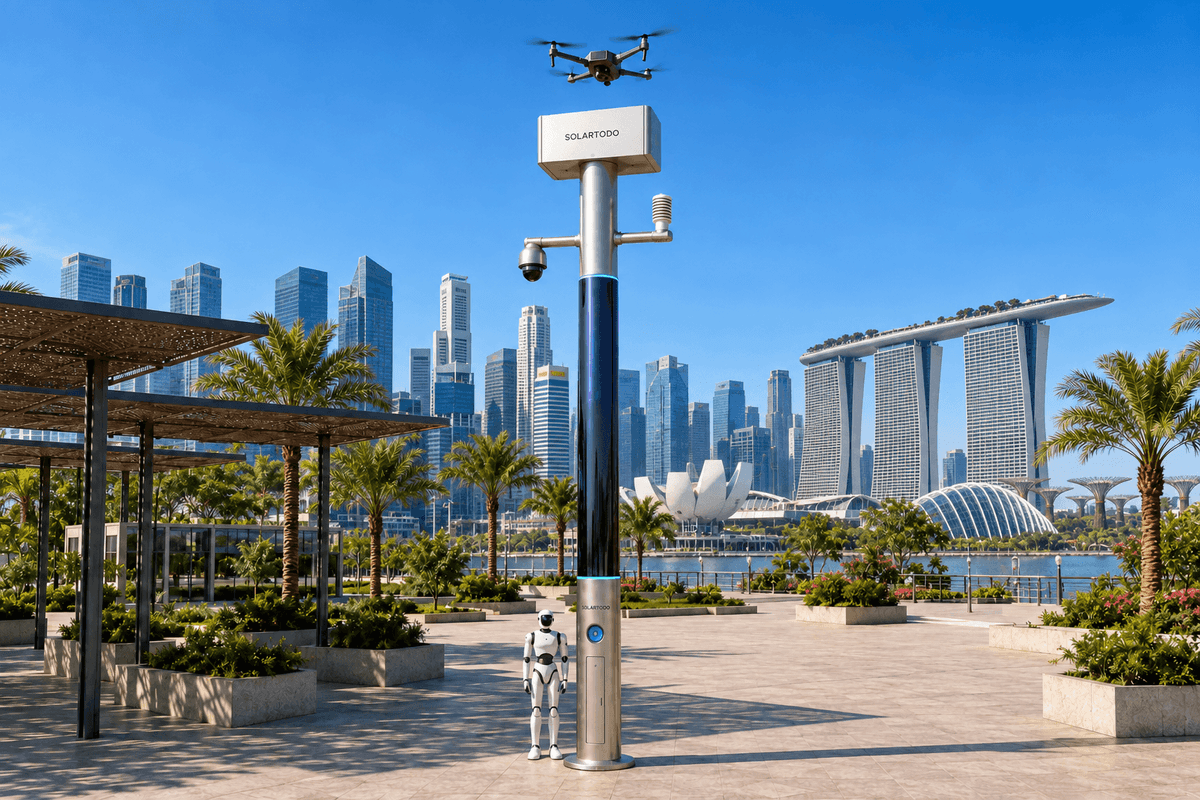
A City AI Pole is a non-lighting physical-AI edge node combining local computing, sensing, autonomous drone support and ground robot operations. SOLARTODO Sentinel’s Sky Hub form runs OTATODO and operates fully off-grid using battery storage and on-pole solar replenishment. This proposed Singapore port deployment coordinates robot patrols and authorized low-altitude inspections during temporary night-economy events.
1. Incident under review: a patrol gap at a temporary waterfront event
The review begins with a hypothetical incident: during an evening waterfront event beside a port-related transport interface in Singapore, a temporary barrier appears displaced near a service access route. A manual patrol is elsewhere, and the command desk cannot immediately establish whether the opening is harmless, obstructed or being used. This is an illustrative planning case, not a report of an actual event, customer deployment or achieved result.
For the transport-authority buyer, the operational problem is slow manual patrol across changing event boundaries. Passenger movement, service access and restricted operational areas require different responses. Sending personnel to every ambiguous observation can stretch the interval between routine checks. A ground robot offers repeatable observation, while an authorized low-altitude inspection can help assess an overhead view that the robot cannot obtain from its route.
Singapore provides a relevant port-city context, but the proposed event location is deliberately unnamed. The case does not imply access to a terminal, government project or protected installation. Maritime safety remains a separate operating responsibility; the Maritime and Port Authority publishes guidance for harbour and pleasure craft operating in port. MPA port safety circular.
The proposed intervention is a temporary SOLARTODO Sentinel Sky Hub station supporting a robot patrol route and a drone nest. Sentinel is positioned as an in-service product; this Singapore configuration remains proposed and subject to final engineering confirmation. The review asks whether coordinated ground and aerial inspection could increase completed patrol checks per operating hour while keeping authorization, energy use and evidence handling explicit.
2. Reconstructing the response: the robot raises the inspection task
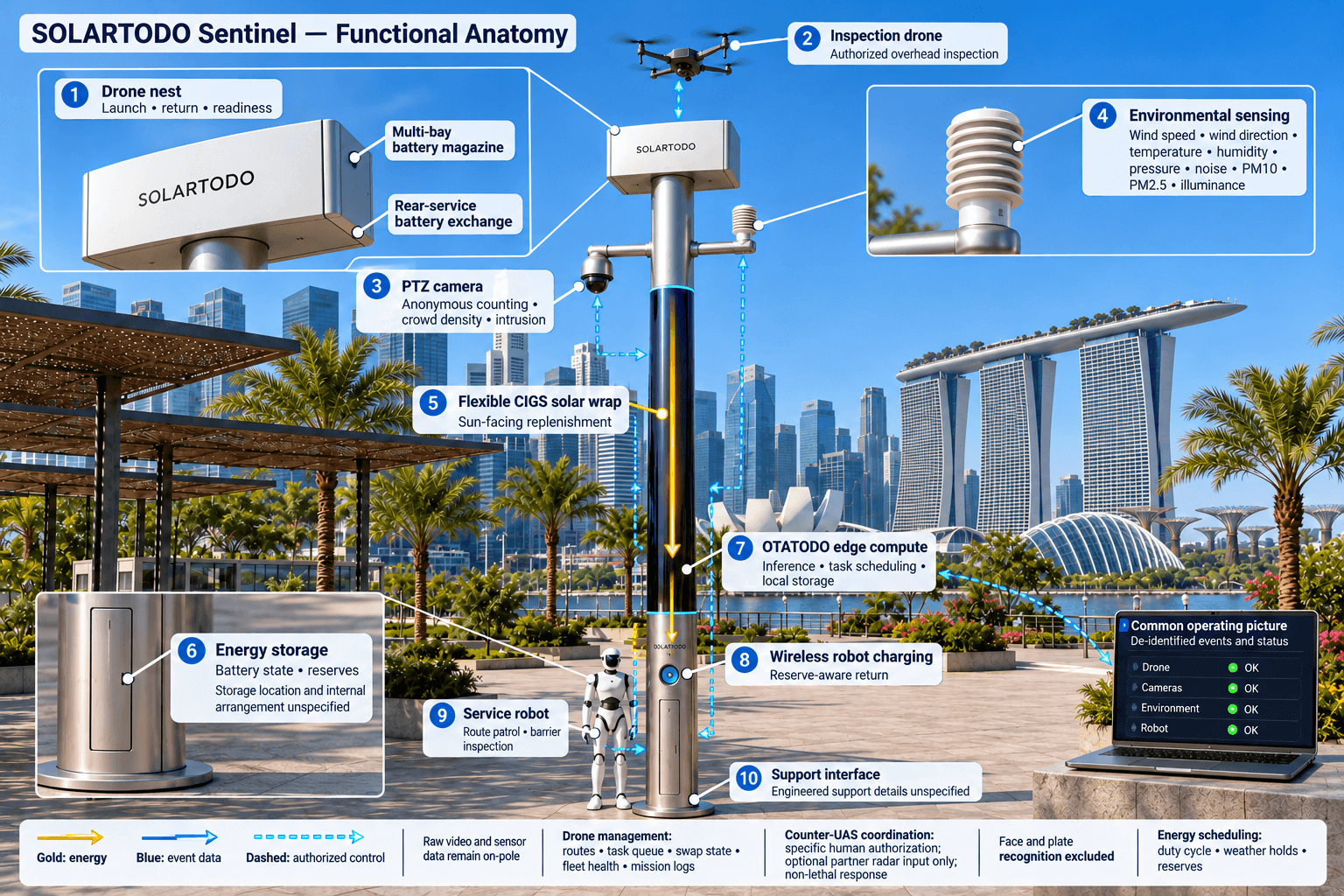
In the illustrative sequence, a service robot follows an approved route along the event’s landside boundary. It detects an obstruction or receives an alarm from the pole’s PTZ camera. The camera supports anonymous vehicle counting, crowd-density assessment, intrusion detection and perimeter awareness. The observation becomes a location-tagged inspection task; face recognition and licence-plate recognition are excluded from this configuration.
OTATODO processes the observation on the pole and presents a de-identified event in a common-operating-picture command view. The reviewer sees the task location, robot condition, drone readiness, battery availability and applicable operating restrictions. Raw video and sensor data remain on the pole. The remote view receives only de-identified event and status metadata; detailed source review requires an authorized local workflow.
A human supervisor assesses the event and authorizes an appropriate response. The robot can approach along its permitted route, inspect the barrier and report whether the path remains accessible. Where an aerial perspective is justified and permitted, the supervisor releases a low-altitude inspection task. The robot remains the primary field asset: the drone supplies a complementary view, then the robot checks the ground condition and supports closure.
Autonomous sorties do not require an operator standing at the nest, but they remain subject to authorized supervision and approved operating conditions. Singapore’s aviation authority explains that operator and activity permits depend on the aircraft, purpose and location of operation. The buyer must establish the applicable permissions before scheduling flights. CAAS operator and activity permits.
The response therefore connects sensing, authorized assessment, edge-compute scheduling and field operations and maintenance in one command workflow. A returned inspection does not automatically close the incident: the responsible supervisor records the disposition and any maintenance follow-up.
3. Why the drone nest matters to a robot-led patrol
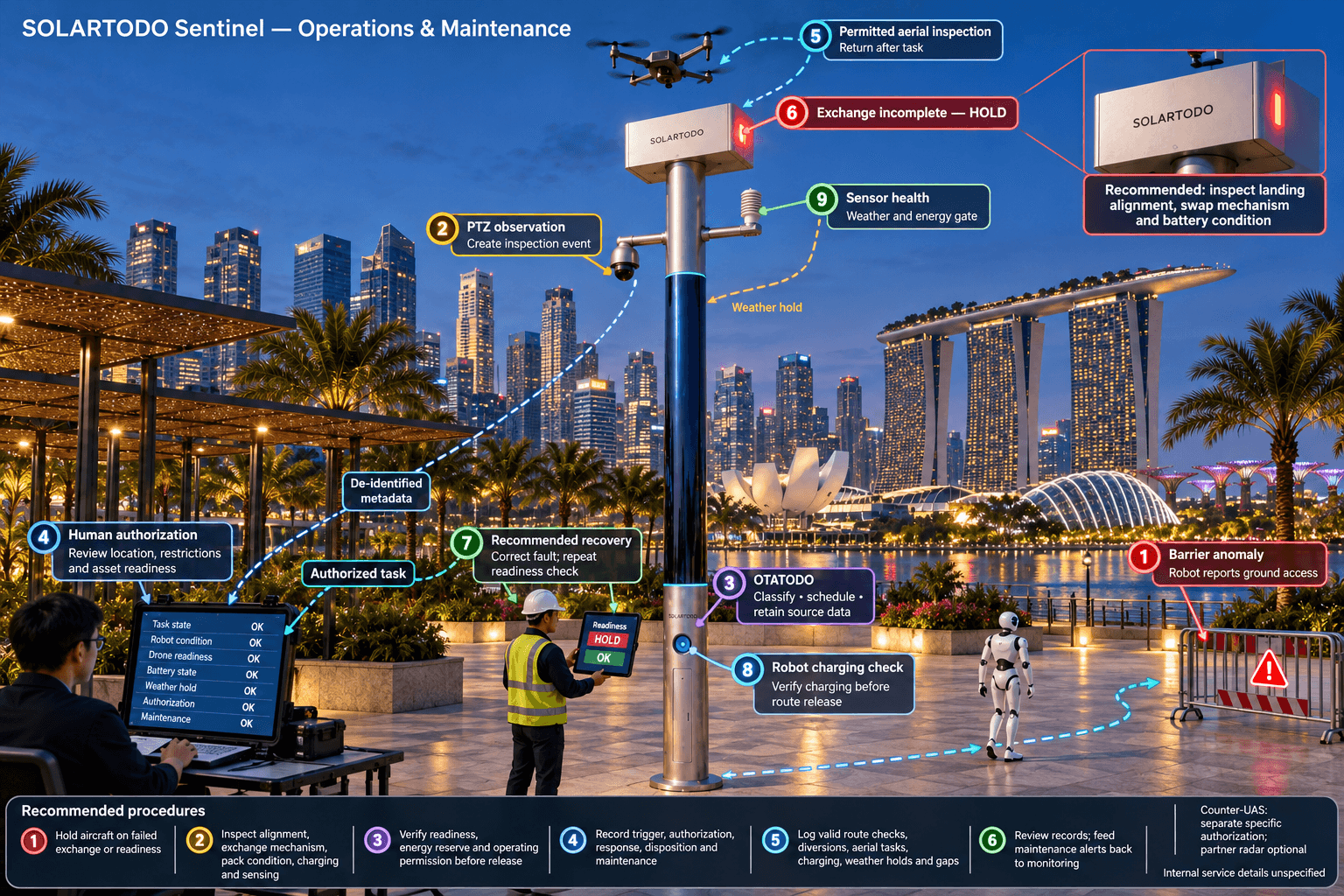
The drone nest addresses the gap between requesting an aerial check and preparing the next sortie. A drone launches for the authorized inspection, patrols its assigned region, returns and becomes available for task redeployment. On landing, a multi-bay battery magazine performs an automated rear-service battery exchange. The aircraft receives a charged pack rather than waiting for its depleted pack to recharge before every relaunch.
Multiple battery bays support several consecutive sorties, subject to pack availability, thermal condition, aircraft checks and the station’s energy budget. This is a repeat-mission capability, not a promise of continuous flight. Operations management maintains route plans, the charge-and-swap state machine, task queues, fleet health and mission logs. An incomplete exchange or failed readiness check keeps the aircraft unavailable and alerts the supervisor.
For the ground robot, that readiness changes how tasks can be divided. The robot continues scheduled patrols and alarm response while the drone inspects a permitted overhead viewpoint. After coordination, the robot returns to the pole base for wireless charging when its schedule and reserve require it. The evaluation records whether aerial assistance preserves ground-route frequency or merely shifts waiting time elsewhere.
The supporting node integrates nine capability groups: the pure smart pole, drone operations, automated battery exchange, drone management, ground robot operations, security sensing, environmental monitoring, edge AI compute and counter-UAS coordination. Environmental monitoring covers wind speed, wind direction, temperature, humidity, atmospheric pressure, noise, PM10, PM2.5 and illuminance. These readings inform operations; illuminance measurement does not mean the pole contains a lighting system.
Counter-UAS coordination remains a separate, human-authorized workflow. Sentinel detects and tracks an unauthorized drone and can command its own friendly drone for soft aerial net-capture or close-approach deterrence only when specifically authorized. The response is non-lethal. Radar is not built into the pole; any radar information would come from an optional partner-sensor input. Event approval alone does not authorize an interception.
4. Deployment constraints exposed by the night shift
A temporary-event station must be engineered around its actual location and duty cycle. The proposed Sky Hub is a PURE smart pole with no lighting system. It operates fully off-grid using on-pole solar replenishment and battery storage, with no grid, city or site power. Temporary deployment describes the installation period; an approximately eight-metre structure still requires engineered support, lifting access, safe separation and an agreed removal plan.
The energy design uses approximately 15 m² of flexible CIGS thin-film wrapped through 360 degrees around a roughly eight-metre-tall, 0.6-metre-wide cylindrical body. The installed nameplate is approximately 2.4–2.7 kWp. However, direct sunlight reaches the cylinder’s sun-facing projection, not the entire wrapped area simultaneously. Nameplate capacity cannot be treated as continuously available charging power.
For reference, a high-irradiance region such as Saudi Arabia can yield roughly 0.8–1.1 kW DC clear-sky peak and about 6–9 kWh per day from this geometry, with peaks in mid-morning or afternoon rather than necessarily at noon. Those figures are not a Singapore yield forecast. Local shading, cloud cover, weather and installation geometry require a separate energy assessment.
Night-economy operations draw on stored energy accumulated beforehand. The proposed 5–20 kWh-class storage buffers compute, sensing, battery exchange and robot charging loads. OTATODO schedules high-power tasks by duty cycle and preserves defined reserves. Consecutive cloudy days, battery losses and unavailable flight windows must be included in the event energy plan. The solar wrap is supplemental replenishment, not unlimited solar self-sufficiency.
An on-pole edge module runs inference and schedules workloads. Raw video and sensor data stay on the pole; only de-identified event and status metadata may leave. The architecture is designed for local processing and is PDPL/LGPD-oriented, without claiming certification or established Singapore compliance. The transport authority must separately review its applicable privacy duties, retention settings and access controls.
5. Review finding: evaluate patrol frequency before procurement
The incident review yields an evaluation question rather than an achieved outcome: can the robot complete more scheduled checks when the drone nest handles authorized aerial inspection and battery turnaround? Patrol frequency should be defined as completed, valid checks of an agreed route or checkpoint per operating hour. A launch, an alarm acknowledgement or an unfinished route does not count as a completed patrol.
Before the temporary event, the buyer should document the manual baseline using the same boundaries, operating window and checkpoint definitions. During evaluation, logs should distinguish scheduled robot rounds, alarm diversions, aerial inspections, charging periods and weather holds. Repeated observations of one easy checkpoint must not inflate the apparent frequency across the whole route. Long gaps between checks should remain visible even when the overall average improves.
The planning arithmetic below uses hypothetical inputs only. For example, an eight-hour window with one completed check per hour produces eight checks; a target interval of thirty minutes produces sixteen. The resulting twofold target is a comparison to test, not a measured Sentinel performance claim. Route length, pedestrian interaction, authorization time and energy availability determine whether the target is feasible.
At the end of each shift, the supervisor reviews the common-operating-picture record: what triggered inspection, who authorized action, which assets responded, whether the check completed and why any task was deferred. Maintenance staff then inspect landing alignment, swap mechanisms, battery condition, robot charging and sensor health. This closes the sensing-to-maintenance loop rather than treating mission completion as the end of accountability.
A procurement decision should follow verified operating evidence and final engineering confirmation. The proposed configuration succeeds as an evaluation only if it exposes both useful patrol capacity and its constraints. For Singapore’s temporary port-interface night activity, the practical objective is a dependable rhythm of robot checks supported by permitted aerial inspection, with accountable decisions and a demonstrable off-grid energy budget.
System Configuration
| Parameter | Configuration |
|---|---|
| Pole and temporary installation | PURE non-lighting pole; approximately 8 m tall and 0.6 m body diameter; engineered temporary support subject to site assessment |
| Off-grid energy | Approximately 15 m² of 360° flexible CIGS wrap, 2.4–2.7 kWp nameplate; 5–20 kWh-class battery storage; no external power connection |
| Drone nest | Autonomous launch and return interface with multi-bay magazine and automated rear-service battery exchange |
| Ground robot interface | Service robot patrol, alarm response and inspection with wireless charging at the pole base |
| Edge compute and command | On-pole inference module running OTATODO; workload scheduling, mission logs and human authorization through a common-operating-picture view |
| Security and environmental sensing | PTZ camera plus wind speed, wind direction, temperature, humidity, pressure, noise, PM10, PM2.5 and illuminance sensing |
| Data boundary | Raw video and sensor data retained and processed on-pole; outbound communication limited to de-identified event and status metadata |
How It Works
- The robot or pole camera flags a possible barrier or access-route anomaly.
- On-pole AI classifies the observation and creates a de-identified inspection event.
- A human supervisor assesses the event and authorizes a permitted response.
- OTATODO schedules robot inspection and, where authorized, a supporting drone sortie.
- The drone returns for automated battery exchange while the robot reports ground conditions.
- The supervisor records disposition, patrol completion and maintenance follow-up.
Planning Assumptions (Indicative)
Illustrative planning inputs a buyer can recompute — target metrics, not achieved results. Subject to final engineering confirmation.
| Metric | Planning assumption | Indicative value |
|---|---|---|
| Manual baseline checks | ILLUSTRATIVE ONLY: assume an 8-hour event window and 1 completed route check per hour; replace with observed baseline inputs. | 8 hours × 1 check/hour = 8 checks per event window |
| Target patrol frequency | ILLUSTRATIVE ONLY: target 1 completed route check every 30 minutes during the same 8-hour window; feasibility requires evaluation. | 8 × 60 ÷ 30 = 16 target checks; 16 ÷ 8 = 2 times the assumed baseline |
| Aerial inspection task time | ILLUSTRATIVE ONLY: plan 4 authorized aerial inspections at 10 minutes each; this is a workload input, not aircraft endurance. | 4 inspections × 10 minutes = 40 minutes of planned aerial task time |
| Overnight energy planning | ILLUSTRATIVE ONLY: assume 0.25 kW average base load for 8 hours plus 2 kWh for field operations; exclude losses and reserve from this subtotal. | (0.25 kW × 8 hours) + 2 kWh = 4 kWh preliminary load subtotal |
| Review effort | ILLUSTRATIVE ONLY: plan 2 review sessions per week for 4 weeks, lasting 30 minutes each. | 2 × 4 × 30 minutes = 240 minutes of planned review effort |
Deployed Equipment
- SOLARTODO Sentinel Sky Hub non-lighting pole with engineered temporary support
- 360° flexible CIGS thin-film solar wrap
- Battery storage cabinet with energy monitoring
- Drone nest with multi-bay battery magazine and rear-service exchange mechanism
- Inspection drone
- Service robot and base-mounted wireless charging interface
- PTZ camera and nine-parameter environmental sensing assembly
- On-pole compute cabinet running OTATODO with local data storage
Frequently Asked Questions
Is this an actual Singapore deployment with verified results?
This article presents a proposed Singapore configuration through a hypothetical incident review. It does not identify a customer, installed quantity or achieved result. Sentinel is positioned as an in-service product, while the local site design, operating permissions, energy budget and patrol-frequency targets require project-specific confirmation and evaluation.
Why use a drone nest when the primary patrol asset is a ground robot?
The robot supplies repeatable ground inspection and alarm response. The drone adds an authorized overhead perspective when a ground route cannot resolve an observation. Automated rear-service battery exchange supports task redeployment after landing, helping the buyer evaluate whether aerial assistance preserves robot patrol frequency without excessive preparation delays.
Can the station run throughout a Singapore night event without external power?
The station is designed to operate fully off-grid, using battery storage and on-pole solar replenishment. Event duration must fit a confirmed energy budget that includes base loads, robot charging, drone tasks, losses and reserves. The high-irradiance reference yield is not a Singapore forecast, and storage capacity alone does not establish runtime.
Does autonomous operation remove the need for flight authorization?
Autonomous launch, patrol and return describe operational capability, not permission to fly. The proposed deployment requires confirmation of applicable Singapore aviation permissions, location restrictions, operating conditions and supervision arrangements. A remote human supervisor authorizes responses within those boundaries; the absence of an operator at the nest does not remove accountability.
What data can the transport authority receive remotely?
The remote command view can receive de-identified event and status metadata, including task state, authorization records, equipment readiness and maintenance alerts. Raw video and sensor data remain on the pole for local processing. Retention, local access and privacy responsibilities require project review; the architecture does not establish certified or automatic regulatory compliance.
Can counter-UAS response operate automatically during the event?
Detection and tracking can support assessment, but mitigation requires specific human authorization and applicable permissions. The node can coordinate its friendly drone for soft aerial net-capture or close-approach deterrence within approved conditions. Radar is not built into the pole, and any radar information would require an optional partner-sensor input.
Explore Further
- City AI Pole / smart streetlight product line
- More smart-city deployment cases
- Talk to our engineering team
Planning a similar physical-AI deployment for streets, campuses or public spaces? Request an engineering consultation