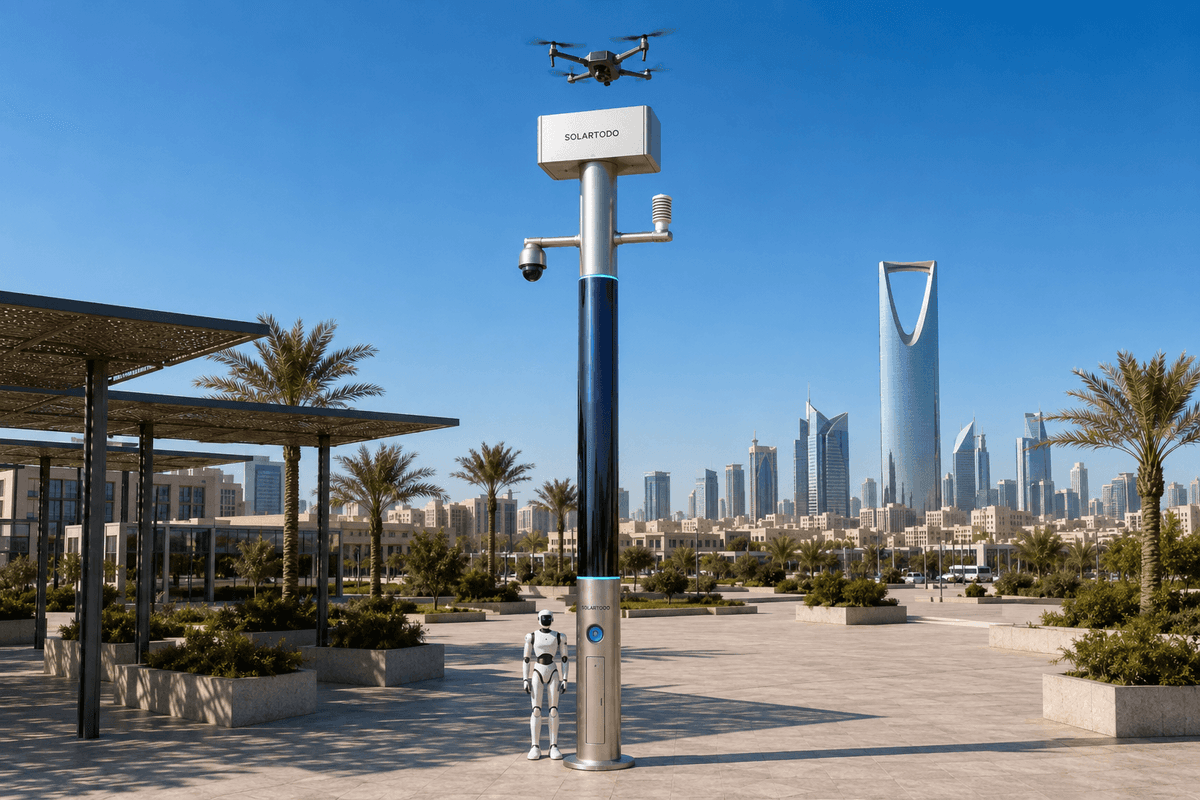
A City AI Pole is a non-lighting urban edge node that combines off-grid energy storage, local AI compute, sensing, drone operations and ground robot coordination in one pole-form station. In this Warsaw configuration, SOLARTODO Sentinel Sky Hub supports CBD border-watch, post-disaster infill and event-period evidence collection while keeping raw video and sensor data on the pole.
1. Warsaw City Task: CBD Border-Watch After Disruption
The Warsaw use case is not framed as street furniture or illumination. It is a city operations task: maintaining an evidence-ready watch boundary around high-pressure CBD zones when a major sports event follows a disruption such as storm damage, flood impact, transport interruption or temporary utility loss. In that window, municipal teams may need fast perimeter awareness around fan routes, bridge approaches, riverside edges, temporary waste and sanitation areas, metro and tram interchanges, contractor access lanes, and restricted service corridors. The buyer lens in this case is eco-environment: the department needs to understand environmental conditions, crowd pressure, noise exposure, waste-zone intrusion and unauthorized access without depending on temporary grid connections or continuous raw data export. The Sentinel Sky Hub is proposed as post-disaster infill infrastructure: a fully off-grid, battery-backed micro-station that can be placed where the normal sensing grid has gaps or where power access is not available. For Warsaw, the relevant geography is the dense central district and its event corridors, not a national-border mission. Border-watch means watching operational boundaries: event perimeters, recovery work zones, protected green edges, temporary logistics gates and critical-infrastructure approaches. The key pain point is evidence collection. A short-lived field report often lacks synchronized camera context, environmental telemetry, drone mission logs and operator authorization history. The proposed Sky Hub configuration turns each node into a local evidence point that can detect, assess, dispatch and record a structured event package while raw video and raw sensor streams stay on the pole.
2. Cross-Department Operating Model
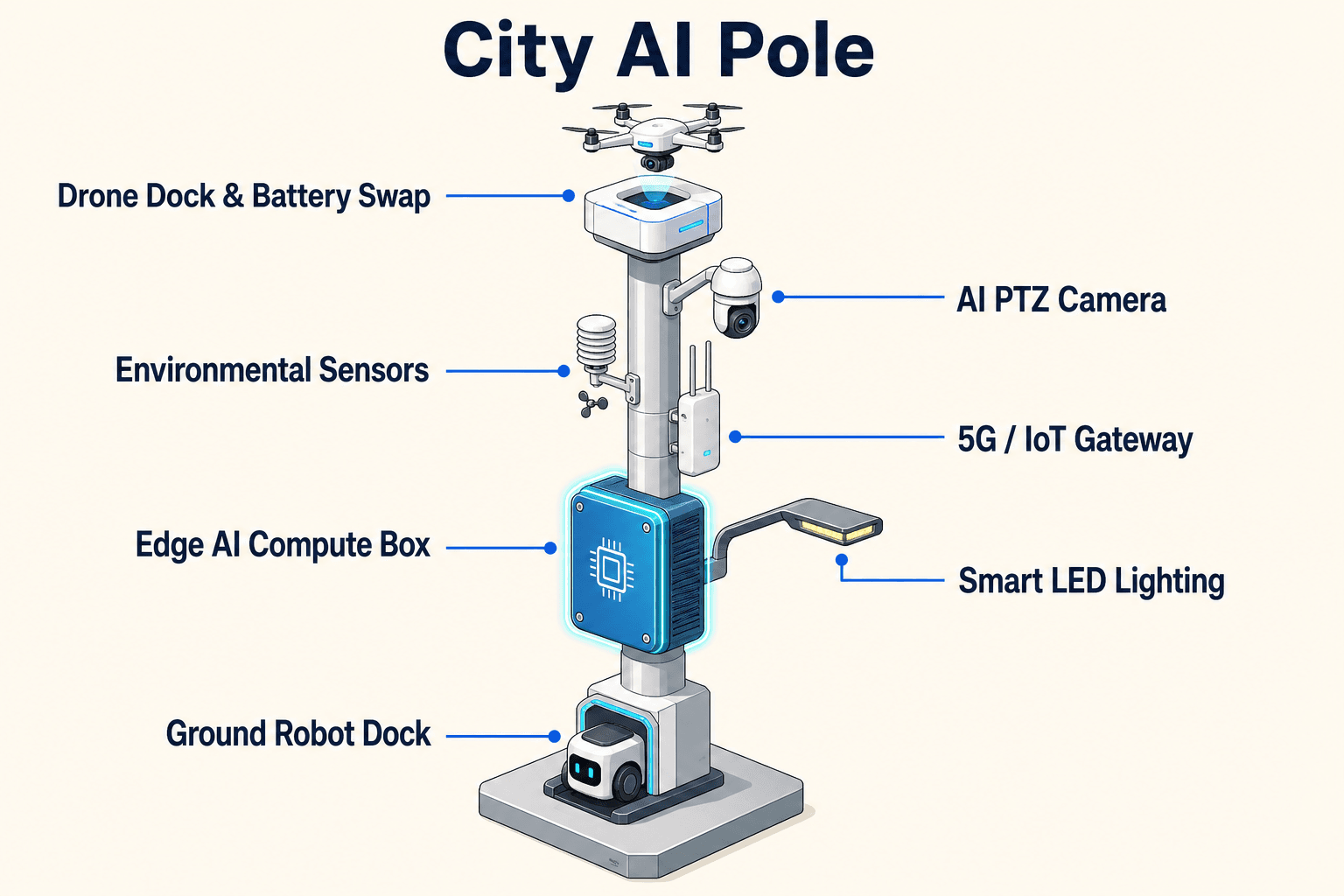
The Warsaw deployment is designed for a shared common-operating-picture command view across environment, crisis management, transport, event security and municipal field operations. Each department sees the same event timeline, but the system separates detection, decision support and action. The eco-environment team receives noise, particulate, wind, temperature, humidity, pressure and illuminance context for each event. Crisis management sees node health, battery state, communications state and whether a drone or ground robot is available. Transport teams can use anonymous vehicle count and crowd density metadata around access points. Security operators receive intrusion, perimeter awareness and unauthorized-drone tracking events, but regulated response remains human-authorized. This matters in a sports-event trigger because field teams face simultaneous priorities: moving crowds safely, preserving emergency access, monitoring air and noise conditions, preventing unauthorized entry into damaged or restricted areas, and keeping a defensible record for after-action review. OTATODO schedules workloads on the pole so high-priority inference, battery-swap readiness, robot charging and environmental sampling are balanced against stored energy. The command view supports the operations loop described as sensing, authorized assessment and response, edge-compute scheduling, and field operations and maintenance. The output is not a continuous surveillance feed. It is a de-identified operational record: event type, time, node state, environmental context, mission status, authorization log and evidence pointer stored locally under policy.
3. Edge Computing As the Evidence Backbone
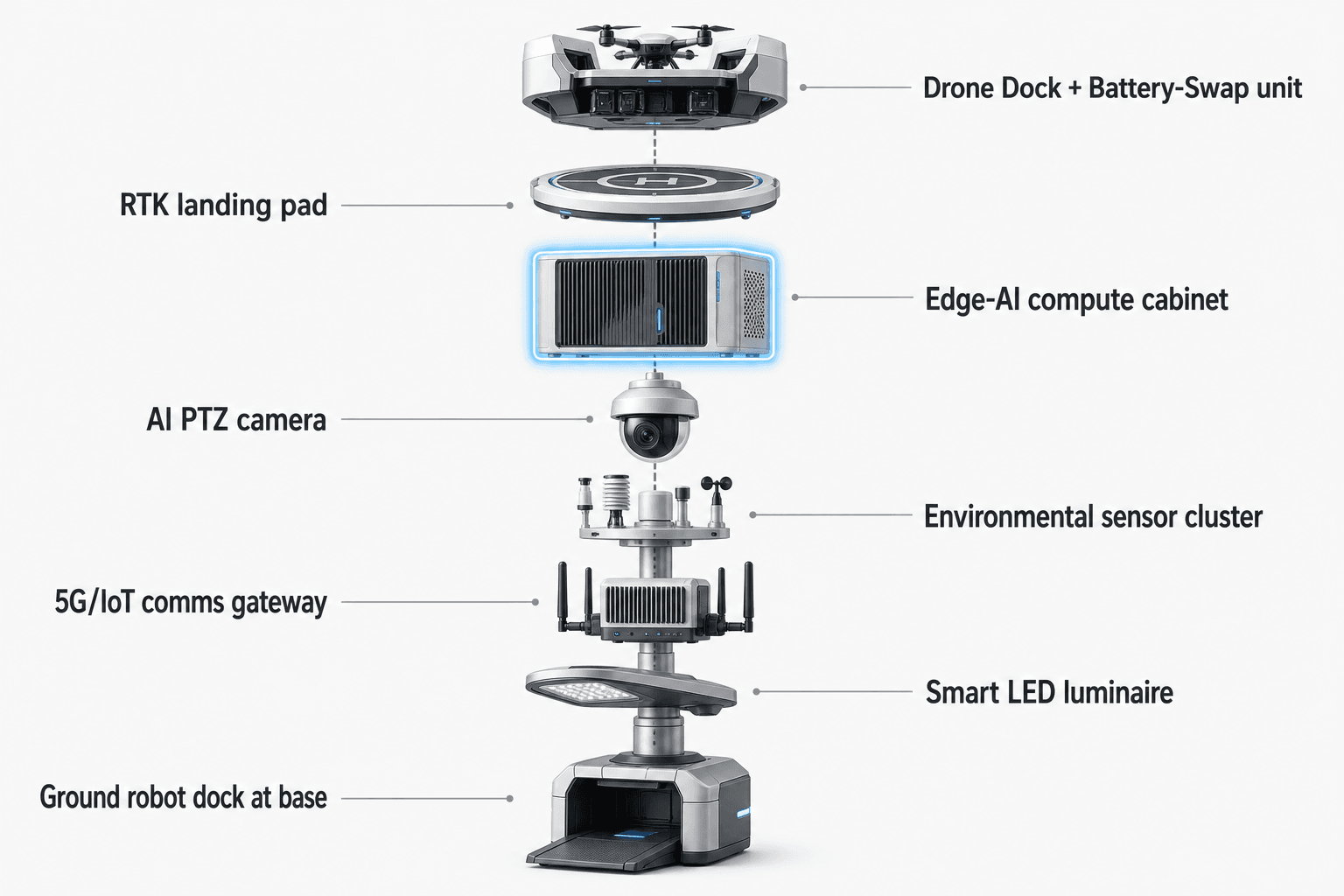
For the evidence-collection pain point, the most important design decision is that raw video and sensor data stay on the pole. A Jetson-class edge module, configured at Orin- or Thor-class depending on final engineering confirmation, runs local perception, sensor fusion, mission scheduling and event packaging. The PTZ camera supports anonymous vehicle count, crowd density, intrusion and perimeter awareness. It is not presented as face recognition or licence-plate recognition. Environmental monitoring records nine planning variables: wind speed, wind direction, temperature, humidity, atmospheric pressure, noise, PM10, PM2.5 and illuminance. Those streams help distinguish a routine crowd-density event from a safety-relevant environmental incident, such as wind-driven dust near a cleanup area or noise spikes around a fan route. Local processing also reduces the burden on city networks during post-disaster infill, when backhaul may be degraded or shared by emergency operations. Only de-identified event and status metadata may leave the pole. The richer evidence object remains locally stored and export-controlled according to policy. This is PDPL/LGPD-oriented data handling: designed for local processing, role-based access, de-identification and auditability, not a claim of certification. For Warsaw, that distinction is important because a CBD sports-event operation has public-space sensitivity, multiple departments and potentially short-term contractor involvement. Edge computing gives the city a way to evaluate response-time targets without turning temporary deployments into cloud-uploaded raw-data systems.
4. Battery-Swap Drone Operations and Robot Coordination
The module focus for this configuration is battery-swap. During a sports-event operation, the value of a drone is not only that it can launch; it is that it can return, receive a charged pack through the Sky Hub multi-bay rear-service battery magazine, relaunch and continue the task queue without an operator standing at the pole. The multi-bay magazine supports several consecutive sorties, subject to airspace permission, weather limits, battery state and duty-cycle rules. For Warsaw CBD border-watch, this can support inspection of a blocked service gate, confirmation of debris near a riverside path, verification of an alarm along a temporary perimeter, or a quick look at crowd accumulation before a field team is dispatched. The drone operations management layer handles route planning, charge and swap state machine, task queueing, fleet health and mission logs. A ground service robot complements the air layer by patrolling lower-speed spaces, inspecting surfaces, responding to alarms, coordinating with the drone view and returning to the pole base for wireless charging. The pole also supports C-UAS coordination within strict boundaries. It may detect and track an unauthorized drone, then command its own friendly drone to perform a soft aerial net-capture or close-approach deterrence only after human authorization. This is non-kinetic and human-authorized mitigation, not shoot-down, jamming, denial or autonomous attack. Radar is not built into the pole; it can be treated only as an optional partner-sensor input if the city already has an approved sensor source.
5. Off-Grid Energy and KPI Evaluation
The Warsaw proposal assumes the Sky Hub remains fully off-grid: no grid, city or site power. Energy is supplied through battery storage plus 360-degree-wrapped flexible CIGS thin-film solar replenishment. The cylindrical body is approximately 8 m tall and 0.6 m wide, carrying about 15 m2 of wrapped CIGS, corresponding to roughly 2.4 to 2.7 kWp nameplate. That nameplate is not a field-output promise. Because a vertical cylinder collects direct sun only on its sun-facing projection, not the whole wrap at once, a realistic clear-sky output in a high-irradiance region such as Saudi Arabia is roughly 0.8 to 1.1 kW DC peak, usually peaking mid-morning or mid-afternoon rather than noon, and about 6 to 9 kWh per day. Warsaw planning should be more conservative, especially in winter and during poor weather, so the CIGS layer is treated as supplemental replenishment for a battery-backed micro-station, not unlimited pure-solar self-sufficiency. High-power drone and robot tasks are buffered by 5 to 20 kWh-class storage and scheduled by duty cycle. The KPI framing is response-time: time from anomaly detection to authorized assessment, drone or robot tasking, field dispatch decision and evidence package creation. These are target evaluation metrics for procurement and acceptance planning, not achieved results.
System Configuration
| Parameter | Configuration |
|---|---|
| Deployment category | city-ai-pole / physical-AI urban edge node; pure non-lighting smart pole |
| Energy system | fully off-grid battery-backed micro-station with 360° flexible CIGS replenishment, 5-20 kWh-class storage |
| Edge AI compute | Jetson-class on-pole inference cabinet, Orin- or Thor-class subject to final engineering confirmation |
| Drone module | roofline autonomous launch and return with multi-bay rear-service battery hot-swap magazine |
| Robot module | ground service robot patrol interface with pole-base wireless charging and mission coordination |
| Sensing package | AI PTZ, anonymous vehicle count, crowd density, intrusion and perimeter awareness plus nine-parameter environmental station |
| Data handling | raw video and sensor data processed locally; only de-identified event and status metadata may leave the pole |
How It Works
- On-pole sensing flags an intrusion, crowd-density, environmental or unauthorized-drone anomaly.
- Edge AI classifies the event locally and assigns a confidence and urgency score.
- The COP view presents de-identified metadata, node status and recommended next action.
- A human operator authorizes drone, robot or field-team response where required.
- OTATODO schedules the sortie, robot task or maintenance action against battery and workload state.
- The pole stores the raw evidence locally and exports only approved event and status metadata.
Planning Assumptions (Indicative)
Illustrative planning inputs a buyer can recompute — target metrics, not achieved results. Subject to final engineering confirmation.
| Metric | Planning assumption | Indicative value |
|---|---|---|
| Response-time evaluation | target measures the interval from local anomaly flag to authorized tasking decision | ~2-5 minute target window |
| Inspection labor | drone and robot patrols replace a portion of manual perimeter checks during event periods | ~10-20 patrol tasks/week automated |
| Evidence packaging | each confirmed event produces a local record with event metadata, environmental context and mission log pointer | ~1 structured package/event |
| Battery-swap continuity | multi-bay magazine enables consecutive sorties before manual service visit, subject to duty cycle | ~3-6 sortie cycles/service window |
| Manual escalation load | edge filtering reduces routine raw-feed review by surfacing de-identified events first | ~30-50% fewer routine review items targeted |
Deployed Equipment
- SOLARTODO Sentinel Sky Hub non-lighting pole body
- 360° wrapped flexible CIGS thin-film solar skin
- Battery storage and BMS cabinet
- Jetson-class edge AI compute cabinet
- AI PTZ camera
- Nine-parameter environmental monitoring station
- Autonomous drone launch and battery hot-swap module
- Ground service robot wireless charging base
Frequently Asked Questions
Is Sky Hub a smart streetlight for Warsaw streets?
No. In this configuration Sky Hub is a pure smart pole and physical-AI edge node with no lighting system. It is positioned for edge computing, drone operations, ground robot coordination, sensing, environmental monitoring and evidence collection around operational boundaries, not for roadway or pedestrian illumination.
How does the system handle personal or sensitive data?
The proposed Warsaw configuration is designed around local processing. Raw video and raw sensor data stay on the pole and are processed by the edge module. Only de-identified event and status metadata may leave the pole under policy. The wording is PDPL/LGPD-oriented and privacy-law aware, not a claim of certification.
What makes battery-swap important for the sports-event scenario?
Battery-swap changes drone operations from a one-off launch into a managed service loop. A landed drone can receive a charged pack from the multi-bay magazine and return to the task queue, allowing several consecutive inspection or evidence-collection sorties without placing an operator at the pole, subject to authorization and airspace rules.
Can the node respond to unauthorized drones?
The node can detect and track an unauthorized drone and coordinate a friendly drone response when authorized. Mitigation is limited to non-kinetic actions such as soft aerial net-capture or close-approach deterrence. It does not shoot down, jam, deny signals or autonomously attack, and regulated response remains human-authorized.
Does the off-grid system run only on solar power?
No. The system is fully off-grid, but the CIGS wrap is a supplemental replenishment layer for a battery-backed micro-station. High-power drone and robot operations are buffered by storage and scheduled by duty cycle. Solar output depends heavily on season, weather, orientation and site engineering confirmation.
Which Warsaw departments would use the common operating picture?
The proposed operating model is cross-departmental. Eco-environment teams use environmental and evidence context, crisis management sees node and battery readiness, transport teams view anonymous flow indicators, event operations manage temporary perimeters, and authorized security stakeholders handle intrusion or C-UAS decisions inside defined rules of engagement.
Explore Further
- City AI Pole / smart streetlight product line
- More smart-city deployment cases
- Talk to our engineering team
Planning a similar physical-AI deployment for streets, campuses or public spaces? Request an engineering consultation