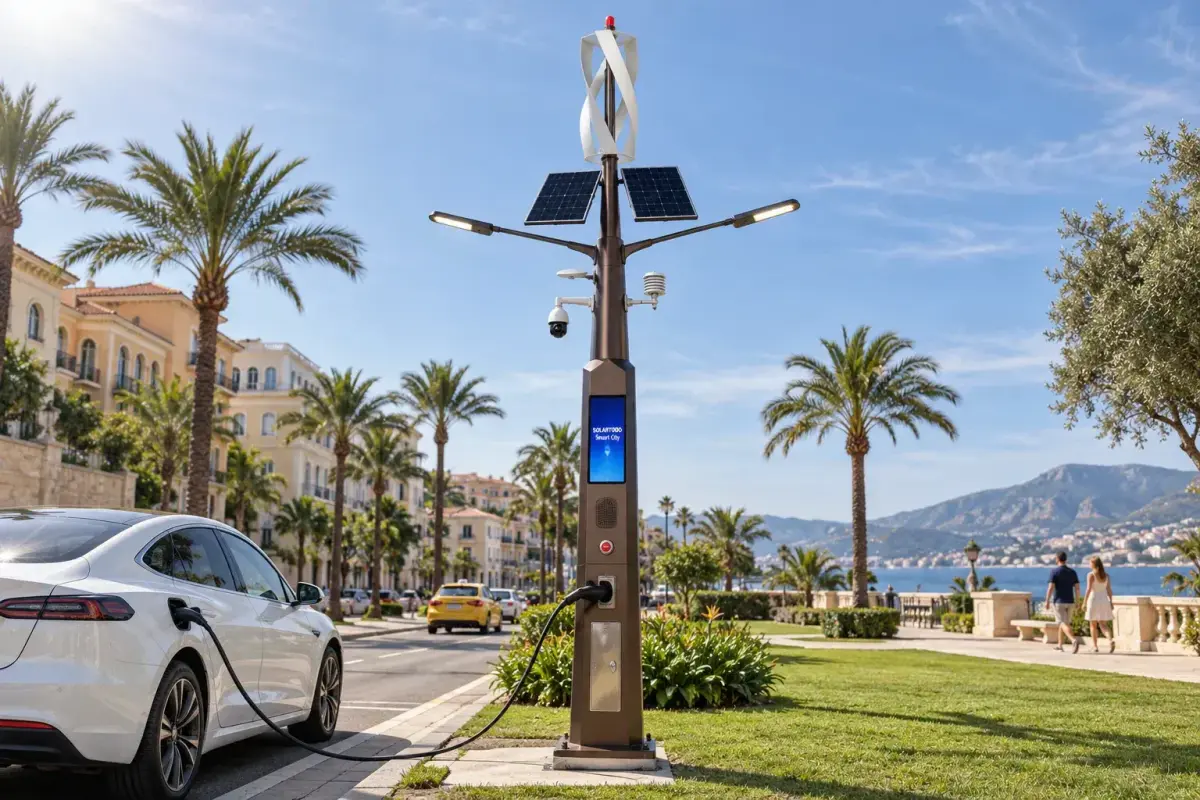
11m Wind-Solar Hybrid Smart Pole · Campus & Park — Integrated EV Charging
Key Features
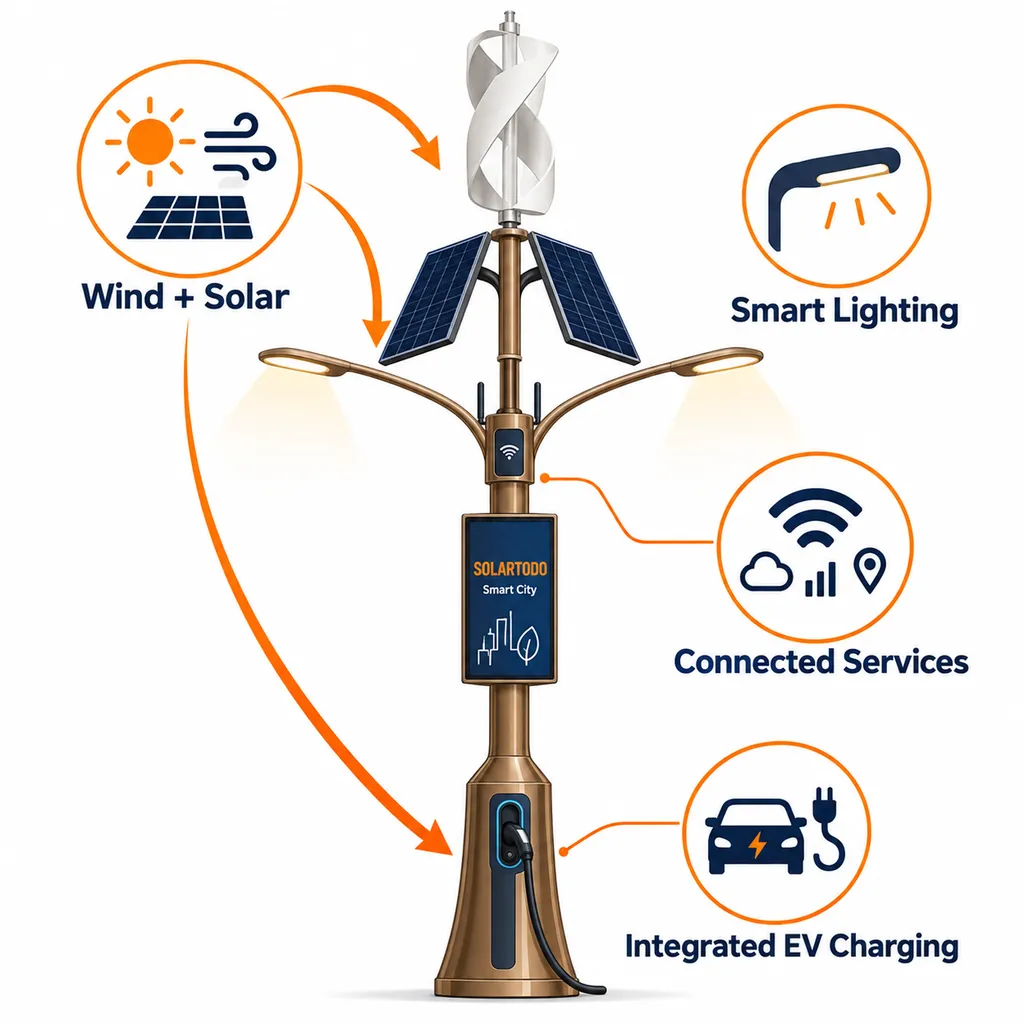
- 11 m octagonal steel structure with a continuously integrated 2.2 m EV charging cabinet and RAL 8011 finish.
- 500 W H-type wind turbine plus 2 × 150 W solar panels and 10 kWh nominal LFP storage, supported by grid backup.
- 2 × 80 W luminaires at 150 lm/W and 4,000 K, providing 24,000 lm combined nominal output.
- 7 kW dual-connector AC charging with 2 Type 2 interfaces, OCPP 1.6J, and 5 m coiled cables; power sharing requires confirmation.
- 4 MP surveillance, 12-parameter sensing, 2 × 30 W IP speakers, and WiFi 6 with a 256-client specification.
The hybrid12 smart pole combines an 11 m steel structure, 500 W wind turbine, 300 W solar array, 10 kWh LFP battery, and twin 80 W LED luminaires. Its integrated services include 7 kW dual-connector EV charging, surveillance, environmental monitoring, WiFi 6, emergency assistance, and a portrait information display, with grid support for high-demand operation.
Description
The 11m Wind-Solar Hybrid Smart Pole · Campus & Park combines a 500 W vertical-axis wind turbine, 300 W of monocrystalline solar capacity, 10 kWh LFP storage, and grid backup within an 11 m multifunction structure. Its 10-in-1 configuration integrates twin 80 W luminaires, surveillance, environmental monitoring, communications, public address, emergency assistance, information display, and a 7 kW dual-connector AC charging system for campus and park infrastructure.
System Architecture
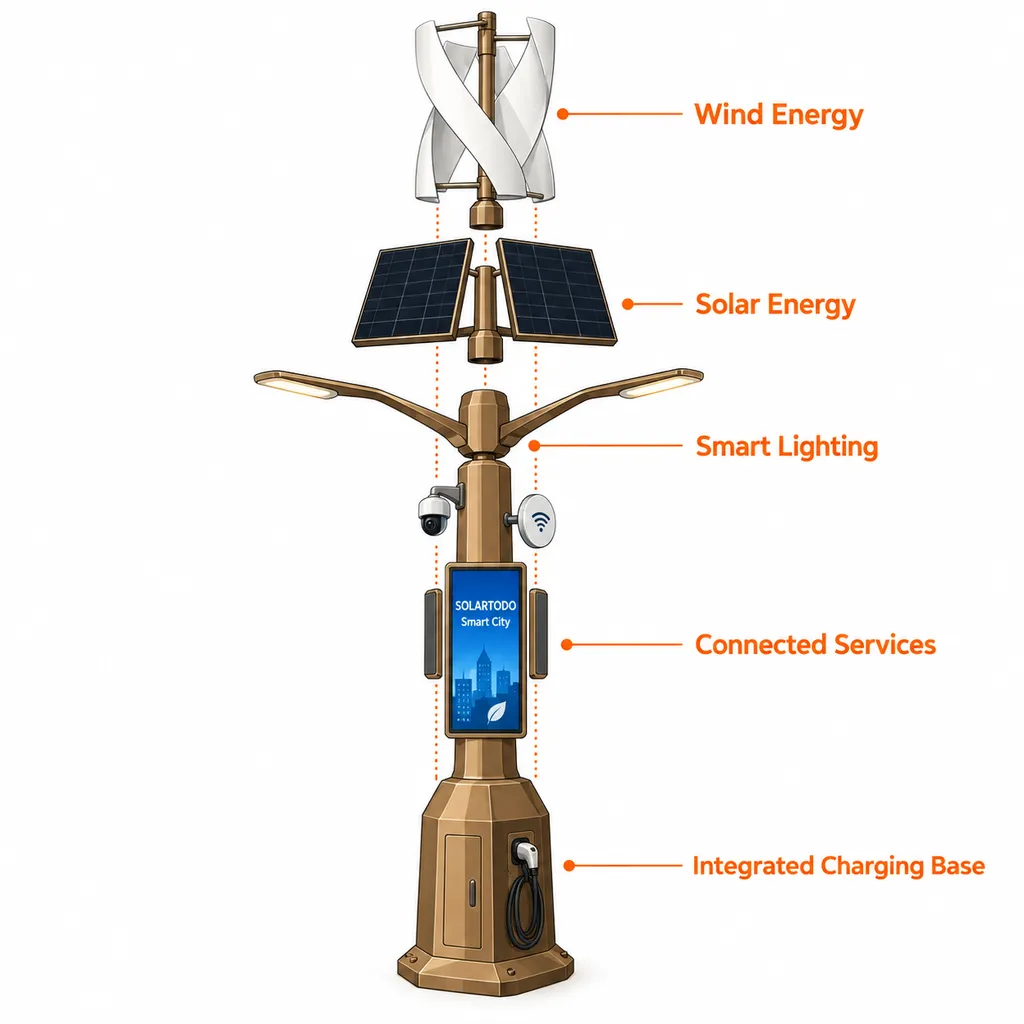
The hybrid12 design specifies an octagonal tapered steel pole measuring approximately 450 mm at the base and 150 mm at the top, finished in antique bronze RAL 8011. The lower 2.2 m is the charging cabinet: it forms one continuously welded steel structure with the shaft. There is no separate charger pedestal. Battery access, charging controls, protective equipment, and cable management require coordinated internal compartment layouts.
The reference configuration comprises 64 poles at nominal 35 m spacing, subject to site geometry and lighting calculations. Each assembly combines renewable generation, storage, lighting, and connected services around one foundation. Structural engineering must account for the 1.28 × 2.56 m screen, turbine dynamics, solar brackets, maintenance openings, and local wind exposure. A numerical wind-survival rating cannot be assigned without the complete structural calculation and foundation design.
Technical Specifications
The 11 m variant uses its supplied component specifications rather than generic product-family defaults. In particular, luminaire efficacy is 150 lm/W, rather than the 170 lm/W template value. The following figures describe the requested configuration; enclosure ratings, operating limits, and lifetime targets require confirmation against the selected components and project documentation before purchase.
| Parameter | hybrid12 specification |
|---|---|
| Structure | 11 m octagonal tapered steel; 450–150 mm profile |
| Wind generation | 500 W H-type Darrieus; 3 straight blades |
| Rotor dimensions | 800 mm diameter × 1,100 mm height |
| Solar generation | 2 × 150 W; 300 W total; 15° tilt |
| Battery | 10 kWh nominal LFP; base-mounted |
| Lighting | 2 × 80 W; 150 lm/W; 4,000 K |
| Lighting arms | 2 × 1.5 m; +8° upward tilt |
| Surveillance | 4 MP bullet camera; 50 m nominal IR |
| Environmental sensing | 12-parameter package |
| Public address | 2 × 30 W IP columns; specified 93 dB |
| EV charging | 7 kW specified system; 2 × Type 2; OCPP 1.6J |
| Information display | P5; 1,280 × 2,560 mm; >5,000 cd/m² |
| Wireless access | WiFi 6; 1.8 Gbps nominal; 256-client specification |
| Auxiliary charging | USB-C PD 30 W plus USB-A |
Wind and Solar Generation
The apex-mounted turbine is a 500 W Darrieus H-type VAWT with 3 straight vertical blades, an 800 × 1,100 mm rotor envelope, and a red aviation warning LED. Rated output is a nameplate value at an unspecified rated wind speed, not continuous production. Request the power curve, starting behavior, braking arrangement, vibration limits, and acoustic data. IEC 61400-2:2013 provides the relevant small-wind safety and engineering framework.
The solar subsystem comprises 2 deep-black monocrystalline 150 W panels on symmetric east-west A-frame brackets at 15° tilt. Its combined rating is 0.30 kWp under standard test conditions. Actual yield depends on shading, temperature, soiling, orientation, and conversion losses. Model both orientations separately using PVWatts Version 8, developed by NREL and maintained by NLR; this page does not represent a completed site simulation.
Battery Storage and Load Priorities
The pole base contains a nominal 10 kWh LFP battery and MPPT solar controller. Wind generation also needs a compatible rectifier, controller, and braking or diversion arrangement; an MPPT solar input alone does not establish turbine compatibility. The electrical design must define battery voltage, inverter capacity, isolation, protective coordination, and source transfer. IEC 62619:2022 addresses safety requirements for industrial lithium batteries, including stationary applications.
For an illustrative autonomy calculation, assume 80% usable battery capacity and 90% discharge-path efficiency. Available delivered energy is then 10 × 0.80 × 0.90 = 7.2 kWh. At the 160 W lighting load alone, this equals 45 hours. Camera, network, sensor, speaker, display, and standby loads shorten that duration; temperature, aging, reserve settings, and inverter limits also affect the result.
A 7 kW charging session lasting 1 hour consumes approximately 7 kWh before conversion losses, nearly the entire illustrative 7.2 kWh battery allowance. Consequently, the renewable subsystem cannot support unrestricted charging and advertising operation independently. Configure priority circuits for lighting, SOS, and essential communications, while treating EV charging and the screen as discretionary or grid-supported loads. Grid-connected operation also requires the relevant local interconnection approvals.
Lighting and Conventional Comparison
Twin symmetric 1.5 m arms rise at +8° and carry 2 × 80 W LED luminaires at 4,000 K. At the specified 150 lm/W efficacy, their combined nominal luminous flux is 24,000 lm. Luminaire selection and safety documentation should reference IEC 60598-1:2024. Roadway or pedestrian illuminance, uniformity, glare, and spill light still require a photometric design using the actual optical distribution.
Against an illustrative conventional installation drawing 300 W in total, the 160 W LED pair reduces connected lighting demand by 46.7%. At 12 operating hours nightly and 365 days annually, consumption falls from 1,314 to 700.8 kWh per pole, saving 613.2 kWh. This is a power-based comparison; equal illumination must be demonstrated separately. Renewable production, dimming, and other smart-pole loads are excluded from that particular comparison.
Surveillance, Sensors, and Emergency Response
The specified 4 MP bullet camera sits on a 300 mm short-arm bracket and provides nominal infrared illumination to 50 m. Identification distance depends on lens selection, scene lighting, weather, compression, and target size. The upper environmental package combines 12 meteorological and air-quality parameters, including rain and CO, NO2, and O3 sensing. Procurement documents should identify all channels, measurement ranges, accuracy, calibration intervals, and sensor replacement requirements.
Public address uses 2 symmetric TCP/IP audio columns, each approximately 100 mm in diameter and 500 mm long, rated at 30 W with a specified 93 dB figure. Slim perforated aluminum housings sit flush against opposite flat pole faces and match RAL 8011. The reference distance and measurement conditions for 93 dB require confirmation. SOS activation should trigger the agreed camera linkage, panic alarm, and emergency broadcast sequence.
Integrated EV Charging and Information Display
The 7 kW AC charger occupies the structural lower 2.2 m section and includes 2 Type 2 connectors, 5 m coiled charging cables, a touchscreen, emergency stop, and maintenance door. Until confirmed otherwise, treat 7 kW as the total shared system rating, not 7 kW simultaneously per connector. IEC 62196-2:2025 covers AC connector dimensional compatibility; confirm the contracted edition and supporting reports.
The charging interface specifies OCPP 1.6J for backend communication, transaction records, remote control, and supported charging-management functions. Protocol support alone is not evidence of independent certification: the Open Charge Alliance OCPP 1.6 certification program provides a separate conformance route. The engineering schedule must also specify electrical protection, earthing, metering requirements, load allocation, and the behavior of both connectors when grid capacity is constrained.
The portrait P5 LED display measures 1,280 × 2,560 mm, an area of 3.2768 m², with specified brightness above 5,000 cd/m². Its content is restricted to SOLARTODO Smart City, rendered in white sans-serif text on deep blue, with no additional imagery. Obtain average and maximum electrical demand before sizing the feeder; screen dimensions and brightness do not establish consumption. Schedule dimming and curfews for nearby residences and wildlife-sensitive areas.
Cloud Monitoring
The WiFi 6 access point uses 802.11ax, with a nominal 1.8 Gbps aggregate specification and support for up to 256 associated devices under vendor-defined conditions. It mounts flush to a flat pole face at 8.7 m, with the color-matched housing visually continuous with the steel finish. These figures do not guarantee individual throughput. Backhaul capacity, radio coverage, channel planning, and concurrent traffic determine practical service quality.
For a 64-pole management layout, specify unique asset identifiers and separate operational views for energy, lighting, charging, alarms, and environmental readings. Cloud integration should define timestamps, missing-data indicators, access roles, firmware management, and data-retention policies. Wired Ethernet or a separately specified 4G/5G gateway can provide backhaul; LoRaWAN requires an explicitly selected interface. Subscription fees, SIM plans, and recording storage must be identified in the quotation.
Applications and Representative Scenario
Representative scenario — 64-pole MENA university campus and public park: assume an open pedestrian corridor, selected parking bays, and 35 m nominal spacing. This is a planning example, not a reported deployment. The configuration totals 19.2 kWp solar, 32 kW wind nameplate capacity, 640 kWh nominal storage, and 10.24 kW lighting demand. If every 7 kW charger operated simultaneously, charging alone would require 448 kW.
For an illustrative solar-only estimate, 0.30 kWp × 5 equivalent sun-hours daily × 0.80 performance allowance yields 1.2 kWh per pole daily, or 438 kWh annually. At 64 poles, that equals 28,032 kWh annually before additional storage losses or curtailment. Wind yield is excluded because no measured resource or validated power curve was supplied. Verify energy availability before assigning display schedules or promising charging availability.
EPC Investment Analysis and Pricing Structure
The supplied commercial bands are budgetary USD figures per pole, rather than a verified quotation for every hybrid12 component. The 10 kWh battery, dual-connector charger, 12-parameter sensor, turbine, and large display require a confirmed bill of materials. The lowest published tier must not be interpreted as guaranteed inclusion of the entire configuration. Compare offers using identical equipment, civil scope, destination, and acceptance requirements.
| Pricing tier | Supplied budget range per pole | Scope basis |
|---|---|---|
| FOB Supply | USD 992–3,944 | Equipment supply; named loading port to be confirmed |
| CIF Delivered | USD 1,114–4,431 | Equipment, ocean freight, and insurance to named destination port |
| EPC Turnkey | USD 1,600–5,800 | Agreed engineering, procurement, construction, commissioning, and 1-year warranty |
FOB and EXW are different delivery arrangements; the supplied equipment-only band must be assigned 1 agreed contractual basis. CIF does not automatically include import duties, inland transport, or unloading. EPC should specify foundation engineering, procurement, installation, cabling, protective testing, configuration, commissioning records, and the 1-year warranty. Utility upgrades, unusual ground conditions, permits, communications subscriptions, and taxes require explicit inclusion or exclusion.
| Order quantity | Stated volume discount | Commercial qualification |
|---|---|---|
| 50+ poles | 5% | Eligible negotiated supply value |
| 100+ poles | 10% | Eligible negotiated supply value |
| 250+ poles | 15% | Eligible negotiated supply value |
For the 64-pole reference, the undiscounted EPC band totals USD 102,400–371,200. The 50+ tier indicates a 5% discount, subject to written confirmation of eligible items; freight, taxes, and site labor should not automatically receive that reduction. The accompanying itemized allocation totals USD 4,642 per pole and is an illustrative budgeting worksheet, not supplier-verified component pricing or a binding offer.
For a transparent energy-only payback illustration, assume USD 0.15/kWh electricity. The lighting comparison saves USD 91.98 annually, while 438 kWh of fully self-consumed solar generation offsets another USD 65.70, giving USD 157.68 gross annual benefit per pole. These calculations exclude wind credit, charging revenue, advertising revenue, auxiliary consumption, and service costs. At USD 4,642, simple gross payback is approximately 29.4 years; this is not a bankable return forecast.
If an illustrative conventional lighting installation costs USD 1,500, the incremental investment is USD 3,142 and gross incremental payback is approximately 19.9 years at the same USD 157.68 benefit. The conventional comparator does not include equivalent smart services. An assumed USD 100 annual incremental maintenance allowance reduces net benefit to USD 57.68 and extends incremental payback to 54.5 years. Battery replacements, financing, degradation, and discounting require lifecycle analysis.
Payment options supplied for negotiation are 30% T/T plus 70% against B/L, or 100% L/C at sight. Financing may be discussed for projects above USD 1,000,000, subject to eligibility and approval. EPC construction milestones and warranty start dates require separate agreement. Send the pole count, destination, site drawings, and requested modules to [email protected] for a documented scope and commercial review.
Procurement and Acceptance
For 11 m assemblies, request structural calculations, foundation drawings, corrosion protection details, electrical schematics, battery documentation, photometric files, and functional test procedures. The supplied standards list includes GB/T 37024, whose exact title, edition, and applicability require clarification. IEC references identify relevant technical requirements; no product-specific certificates were supplied. IP66, −40°C to +55°C operation, and a 25-year structural design life remain confirmation targets, not verified whole-system ratings.
Before ordering 64 units, confirm charger power sharing, display demand, battery dimensions, turbine certification evidence, maintenance access, and emergency behavior during source failures. View all Smart Streetlight (10-in-1 Multi-function Pole) products, Configure your system online, or Request a custom quotation. For background on 300 W solar sizing and 10 kWh storage planning, Learn about hybrid energy and smart-lighting design before finalizing the project specification.
Technical Specifications
| Variant | hybrid12 |
| Pole Height | 11m |
| Pole Structure | Octagonal tapered steel; continuously welded integrated charging base |
| Base / Top Dimensions | 450 / 150; measurement convention to be confirmedmm |
| Integrated Charging Section Height | 2.2m |
| Finish | Antique bronze, RAL 8011 |
| Integrated Modules | 10-in-1 product-line configuration |
| Wind Turbine | 500 W H-type Darrieus VAWT; 3 straight blades |
| Rotor Diameter × Height | 800 × 1100mm |
| Solar Capacity | 300; 2 × 150 W monocrystalline panelsWp |
| Solar Panel Orientation | Symmetric east-west pair; 15° tilt |
| Battery | 10 kWh nominal LFP, inside pole base |
| Power Management | MPPT solar controller; compatible wind controller and grid transfer equipment require confirmation |
| LED Power | 160 total; 2 × 80W |
| Luminous Efficacy | 150lm/W |
| Combined Nominal Luminous Flux | 24000lm |
| Correlated Color Temperature | 4000K |
| Luminaire Arms | 2 × 1.5 m; +8° upward tilt |
| Camera | 4 MP bullet; 50 m nominal IR; 300 mm bracket |
| Environmental Monitoring | 12 parameters; meteorology, air quality, rain, CO, NO2 and O3; complete channel list requires confirmation |
| Public Address | 2 × 30 W TCP/IP columns; 100 mm diameter × 500 mm height; specified 93 dB, conditions unconfirmed |
| Emergency Functions | SOS, panic alarm, camera linkage and emergency broadcast trigger |
| EV Charging Power | 7; treated as shared system total pending confirmationkW |
| Charging Connectors | 2 × Type 2; 5 m coiled cables; OCPP 1.6J |
| Charger Controls | Touchscreen, emergency stop and maintenance door |
| LED Display | P5 portrait; 1280 × 2560 mm; brightness >5000 cd/m² |
| Display Content | SOLARTODO Smart City; white sans-serif text on deep blue; no other imagery |
| Communication | WiFi 6 / 802.11ax; nominal 1.8 Gbps and 256 clients; 4G/5G and LoRaWAN require separately specified interfaces |
| WiFi AP Installation Height | 8.7; flush, color-matched housingm |
| Auxiliary Charging | USB-C PD 30 W plus USB-A |
| Nominal Pole Spacing | 35; subject to photometric and site designm |
| Reference Planning Quantity | 64poles |
| Wind Resistance | Not supplied; requires structural and foundation calculations |
| IP Rating | IP66 template target; component and complete-system verification required |
| Operating Temperature | −40°C to +55°C template target; battery charging and subsystem limits require confirmation |
| Energy Saving | 46.7% illustrative lighting power reduction versus 300 W baseline; excludes other modules and requires photometric equivalence |
| Design Life | 25-year structural template target; not a battery life or whole-system warranty |
| EPC Warranty | 1 year; coverage, exclusions and commencement date subject to contract |
Price Breakdown
| Item | Quantity | Unit Price | Subtotal |
|---|---|---|---|
| 11 m integrated steel pole and charger enclosure — budget allowance | 1 pcs | $797 | $797 |
| 500 W VAWT assembly — budget allowance | 1 pcs | $260 | $260 |
| 150 W monocrystalline solar panel — budget allowance | 2 pcs | $65 | $130 |
| 10 kWh LFP battery — budget allowance | 1 pcs | $900 | $900 |
| 80 W LED luminaire — budget allowance | 2 pcs | $65 | $130 |
| Smart cloud gateway — supplied reference allowance | 1 pcs | $92 | $92 |
| 4 MP fixed camera — supplied reference allowance | 1 pcs | $94 | $94 |
| 12-parameter environmental sensor — budget allowance | 1 pcs | $320 | $320 |
| 30 W IP speaker column — supplied reference allowance | 2 pcs | $92 | $184 |
| SOS emergency call module — supplied reference allowance | 1 pcs | $101 | $101 |
| 7 kW dual-connector charger — provisional reference-based allowance | 1 pcs | $201 | $201 |
| P5 portrait LED display — budget allowance | 1 pcs | $500 | $500 |
| WiFi 6 access point — provisional reference-based allowance | 1 pcs | $149 | $149 |
| USB charging module — provisional reference-based allowance | 1 pcs | $34 | $34 |
| Controller, conversion, brackets, wiring and protection package — provisional allowance | 1 pcs | $50 | $50 |
| Installation & Commissioning — budget allowance | 1 pcs | $350 | $350 |
| 1-Year Warranty & Support — budget allowance | 1 pcs | $150 | $150 |
| Engineering & QC — budget allowance | 1 pcs | $200 | $200 |
| Total Price Range | $1,600 - $5,800 | ||
Frequently Asked Questions
Can the pole operate entirely on wind and solar power?
Is the EV charger a separate cabinet, and can both connectors deliver 7 kW?
What are the EPC price range and warranty terms?
Which certifications and environmental ratings are confirmed?
How should a 64-pole campus installation be planned?
Certifications & Standards

Data Sources & References
- •User-supplied hybrid12 configuration: 11 m structure, integrated modules, 64-unit planning reference, and commercial bands; not independently tested.
- •IEC 60598-1:2024 — Luminaires: General requirements and tests. https://webstore.iec.ch/en/publication/66620
- •IEC 61400-2:2013 — Small wind turbines. https://webstore.iec.ch/en/publication/5433
- •IEC 62619:2022 — Safety requirements for industrial lithium cells and batteries. https://webstore.iec.ch/en/publication/64073
- •IEC 62196-2:2025 — AC EV connector dimensional compatibility requirements. https://webstore.iec.ch/en/publication/86317
- •NREL-developed PVWatts Version 8, maintained by NLR — photovoltaic energy estimation methodology; no site simulation performed. https://developer.nlr.gov/docs/solar/pvwatts/
- •Open Charge Alliance — OCPP 1.6 certification program. https://openchargealliance.org/certificationocpp/certification-ocpp-1-6/
- •Illustrative engineering calculations: lighting demand comparison, battery autonomy, solar yield, and simple payback; assumptions stated in description.
Interested in this solution?
Contact us for a customized quote based on your specific requirements.
Contact Us